How a Belgian Chocolate Brand Solved Their Ribbon Supply Chain Nightmare: A Buyer's Honest Account
How a Belgian Chocolate Brand Solved Their Ribbon Supply Chain Nightmare: A Buyer's Honest Account
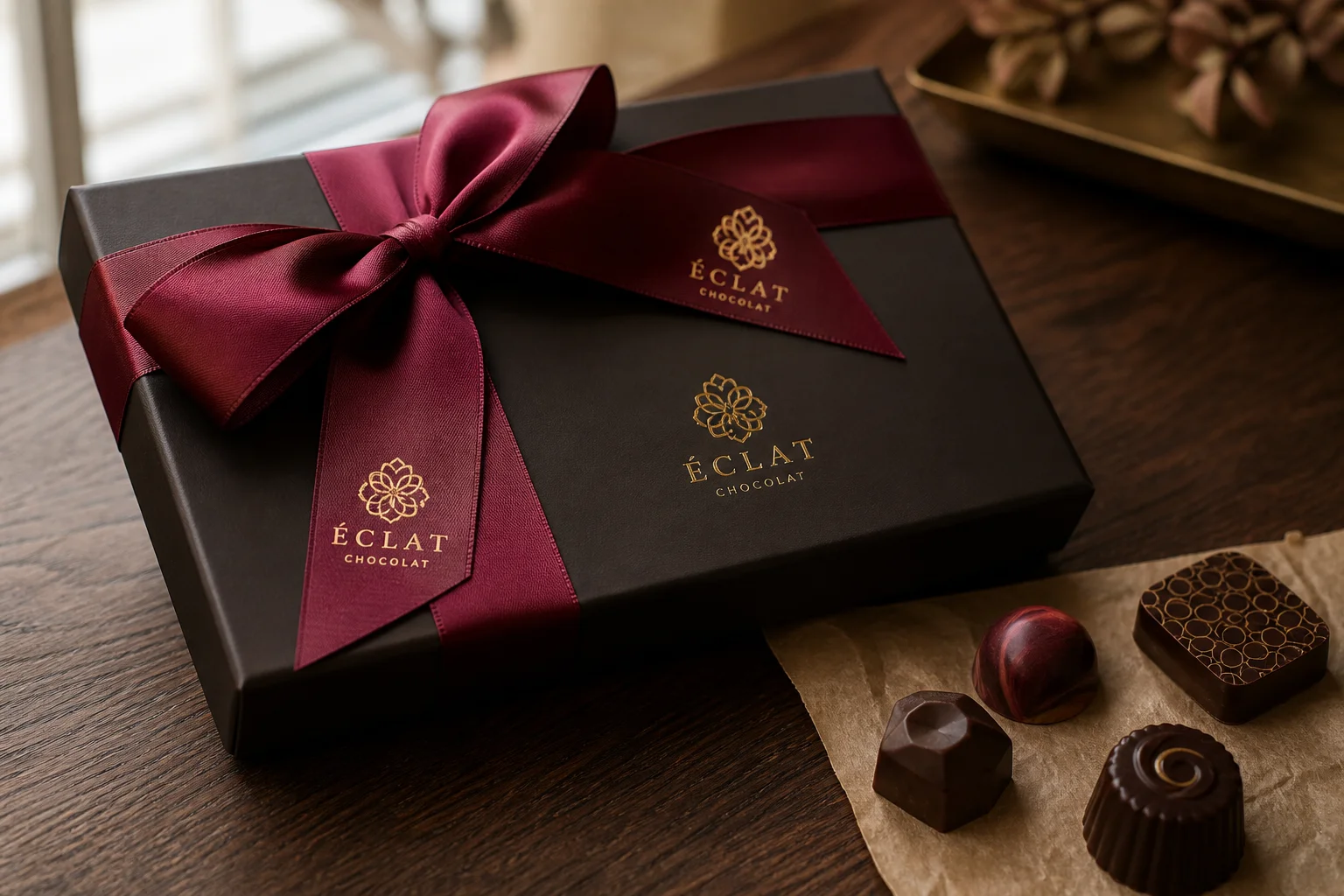
If you source packaging materials for a premium food brand, you already know this feeling: the product is perfect, the box is beautiful, and then the ribbon arrives and it's the wrong shade. Not dramatically wrong — just off enough that the whole presentation falls apart. The burgundy you approved looks more like maroon. The gold print is slightly copper. The width is 2mm narrower than the sample you held in your hand three weeks ago.
This is the story of a Belgian chocolate maker who went through exactly this — not once, but twice — before finding us. And it's also the story of what we learned from working with them, because their problems were not unusual. They're the same problems that every buyer in the premium food packaging space faces when they try to source custom ribbon from overseas.
I'm sharing this with their permission, because the details of what went wrong — and what went right — are the kind of things that most buyers only learn through expensive trial and error.
The Client: Maison du Chocolatier (Name Changed)
Maison du Chocolatier is a mid-sized Belgian chocolate brand based in Brussels. They produce about 200,000 boxes of chocolates per year, sold through their own boutiques in Belgium, France, and the Netherlands, and through luxury department stores like Harrods and Galeries Lafayette.
Their signature product is a 16-piece assortment box. It's a rigid two-piece box in matte black, with a custom-printed ribbon tied around it in a simple bow. The ribbon is 25mm double-faced satin in a deep burgundy color, with the brand name hot-stamped in gold foil on one side. It's been their signature look for over 15 years.
For the first 12 of those 15 years, they sourced their ribbon from a supplier in France. The quality was excellent, the color was consistent, and the delivery was reliable. But the price was high — about 3.5 times what a Chinese supplier would charge for the same specification. And the lead time was 6 to 8 weeks for a custom order, which meant they had to commit to large inventory runs.
In 2023, their procurement director decided to explore overseas sourcing. The potential savings were significant: a Chinese supplier could produce the same ribbon at roughly one-third the cost, and the lead time was only 3 to 4 weeks by sea freight.
First Attempt: The Color Disaster
Their first overseas supplier was a trading company in Guangzhou. The process seemed straightforward: they sent a physical sample of their existing ribbon, the trading company confirmed they could match it, and they placed a trial order of 5,000 meters.
When the ribbon arrived, the color was wrong. Not a little wrong — noticeably wrong. The burgundy was more purple than red. Under the D65 daylight standard, the color difference was obvious. Under the TL84 retail lighting used in their boutiques, it was even more obvious.
The procurement director emailed the supplier. The supplier said: "The color looks the same to us. Maybe your lighting is different." They sent photos. The photos looked fine on the supplier's screen — but photos are not reliable for color comparison. A photo taken under one set of lighting conditions and viewed on a different screen will always look different from the actual physical sample.
The result: 5,000 meters of unusable ribbon, a delayed product launch, and a tense conversation with the finance department about the write-off.
What went wrong? The trading company did not have a color lab. They matched the color by eye, which is a perfectly reasonable approach for standard colors but completely inadequate for custom colors that need to match a specific brand standard. The human eye can distinguish very small color differences when two samples are placed side by side, but it cannot reliably reproduce a color from memory or from a photo.
Second Attempt: The Print Quality Problem
Determined to get it right, the procurement director found a second supplier — this time a factory in Zhejiang that claimed to have its own printing equipment. They sent the same physical sample, along with the artwork file for the hot-stamped logo. The factory confirmed they could match both the color and the print.
The ribbon arrived. This time, the color was much closer — still not an exact match, but acceptable for a first order. The problem was the gold foil print. The logo was supposed to be a crisp, clean gold foil stamp on the burgundy satin. What arrived was a slightly fuzzy print with visible edge bleeding. The gold looked more like copper. And on about 30% of the ribbon, the foil had not fully adhered — you could peel it off with your fingernail.
The procurement director sent a complaint. The factory acknowledged the issue and offered a 20% discount on the next order. But the problem wasn't the price — it was the quality. A luxury chocolate brand cannot put a ribbon with peeling gold foil on their product. The entire point of the ribbon is to signal quality and attention to detail. When the ribbon looks cheap, the product looks cheap.
What went wrong? The factory had hot-stamping equipment, but they were using a lower-grade foil and a faster stamping speed than what's required for a premium result. Premium gold foil (the kind that adheres cleanly and has a true gold color, not copper) is more expensive, and stamping at the correct speed takes longer. The factory had cut corners on both to save cost, without telling the buyer.
How We Got Involved
After two failed attempts, the procurement director was ready to give up on overseas sourcing and go back to the French supplier. But the cost pressure was real — the French supplier had raised their prices by 15% that year, and the brand's margins were already thin.
They found us through our Alibaba storefront. What caught their attention was not the price — it was the color lab photos we had posted. They showed our spectrophotometer, our D65 light box, and our physical color archive. The procurement director told me later: "I had never seen a Chinese ribbon supplier post photos of a color lab before. Most of them just show the finished product. You showed me the process."
He sent us an inquiry with a very specific list of requirements:
Color match: Must match the existing physical sample within ΔE < 0.5 under D65, TL84, and A-source lighting conditions
Print quality: Gold foil hot stamp, no edge bleeding, no peeling, true gold color (not copper)
Width: 25mm double-faced satin, ±0.5mm tolerance
Quantity: 15,000 meters per order, with the option to reorder in smaller quantities
Lead time: 3 weeks from order confirmation to shipment
Compliance: Must meet EU food contact safety standards (the ribbon is on a food product)
This was a serious buyer who had done his homework. He knew exactly what he needed, and he knew the specific technical requirements. Our job was to prove that we could deliver.
The Color Matching Process
When the physical sample arrived at our factory, the first thing we did was measure it on our spectrophotometer. The result: the color was a deep burgundy with a specific set of L*a*b* values. We recorded these values and entered them into our color database.
Then we pulled our closest stock color from our archive of 196+ standard colors. The closest match was a burgundy that was close but not exact — the ΔE was about 1.2, which is visible to a trained eye. We needed to do a custom dye.
Our dyeing team prepared three lab-dip samples — small batches of ribbon dyed to slightly different formulations, all targeting the same color. Each sample was measured on the spectrophotometer and compared against the reference. The first sample was ΔE 0.8. The second was ΔE 0.4. The third was ΔE 0.3.
We sent all three physical samples to the client by DHL. They compared them against their existing ribbon under the D65 light box in their Brussels office. The third sample was an exact match. They approved it.
This is the part that most buyers don't see: the lab-dip process. It takes about 5 working days and costs us money in materials and labor. But it's the only way to guarantee a color match for a custom color. If a supplier skips the lab-dip and goes straight to production, they're gambling with your color. Sometimes they get lucky. Often they don't.
The Hot Stamping Challenge
The gold foil hot stamp was the harder part of this order. The client's logo is a script font with fine lines and thin strokes. Hot stamping fine detail on satin ribbon is tricky because the foil needs to transfer cleanly onto the satin surface without bleeding into the weave.
We ran three test stamps before starting production. The first test used our standard gold foil — the result was good but not perfect. The thin strokes were slightly thicker than the artwork, which is normal for hot stamping but not acceptable for a luxury brand that has been using the same logo for 15 years.
For the second test, we switched to a higher-grade German foil that has a finer particle structure and transfers more precisely. The result was better — the thin strokes were cleaner and the edges were sharper. But the gold color was slightly lighter than the client's existing ribbon.
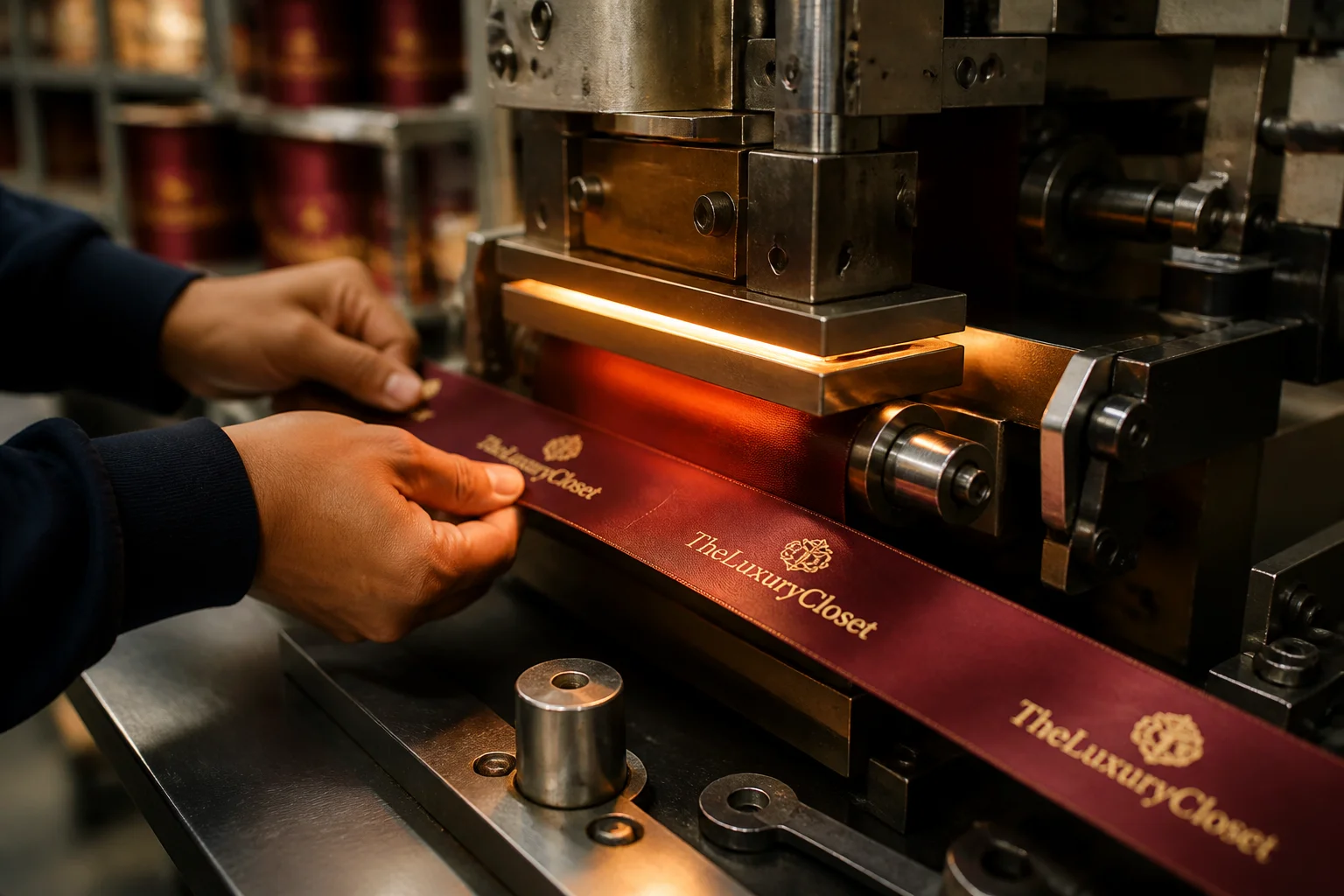
For the third test, we adjusted the stamping temperature and pressure. Lower temperature and lighter pressure with the German foil produced the cleanest result. The thin strokes were sharp, the edges were clean, and the gold color was a true gold — not copper, not bronze.
We sent a photo of the test stamp to the client for approval. They approved it. Only then did we start the production run.
The Production Run
The total order was 15,000 meters of 25mm double-faced satin, custom dyed in burgundy, with a gold foil hot stamp on one side. Here's how we broke down the production:
Greige weaving: 2 days. We had the 25mm double-faced satin greige in stock, so we didn't need to wait for weaving. This is a major advantage of owning our own looms and maintaining a greige inventory — we can start dyeing immediately instead of waiting 2 to 3 weeks for the base ribbon.
Dyeing and color matching: 3 days. The custom dye was done in a single batch to ensure color consistency across the entire 15,000 meters. After dyeing, we measured every 500 meters on the spectrophotometer to confirm the color was consistent from start to finish. The maximum ΔE across the entire batch was 0.3 — well within the 0.5 tolerance.
Heat setting and finishing: 1 day. The dyed ribbon was heat-set to ensure dimensional stability and a smooth, flat surface for the hot stamping.
Hot stamping: 2 days. The stamping was done at a slower speed than our standard production to ensure the fine detail of the logo was reproduced cleanly. We pulled samples every 200 meters and checked the foil adhesion and edge quality.
QC and packaging: 1 day. The finished ribbon was inspected on the inspection table, rolled onto cardboard cores, and packaged in OPP bags with moisture protection.
Total production time: 9 working days. Including shipping from Xiamen to Antwerp by sea (28 days), the total lead time was about 5.5 weeks — slightly longer than the 3-week target, but the client understood that the first order requires extra time for color development and test stamping. Subsequent reorders will be faster because we have the color and stamping parameters on file.
The Cost Comparison
Here's the part that matters most to procurement directors: the cost. Our price for this order was approximately 35% of the French supplier's price. Even with the additional cost of DHL shipping for the lab-dip samples and the slightly longer lead time for the first order, the total cost was less than 40% of what they had been paying.
But the real savings are in the reorders. Now that we have the color formulation, the stamping parameters, and the physical color archive on file, subsequent orders can be produced in 7 to 9 working days. The lab-dip process is only needed for the first order — for reorders, we match against the archived swatch and go straight to production.
The client placed their first reorder two months later — 10,000 meters — and it arrived in 5 weeks from order to delivery. The color matched perfectly. The gold foil was consistent. The ribbon was exactly the same as the first batch.
What We Learned from This Client
Working with a buyer who had been burned twice before taught us a lot about what premium buyers actually need from a ribbon supplier:
1. The lab-dip is not optional. For custom colors, a physical sample approval is the only reliable way to ensure a color match. We now include the lab-dip process as a standard step in our custom color workflow, and we never skip it — even if the client says "just match the photo." A photo is not a color standard.
2. Test stamps are not a waste of time. Running two or three test stamps before production adds a day to the schedule, but it prevents a production run of 15,000 meters of ribbon with a misaligned or blurry logo. The cost of a test stamp is negligible. The cost of a failed production run is enormous.
3. Physical color archives matter. We archive a physical swatch of every custom color we produce. When a client reorders, we match against the swatch — not against a digital file, not against a Pantone code, and not against a photo. The swatch is the truth. Digital files shift across screens. Pantone codes are references, not guarantees. The physical ribbon under actual light is the only reliable standard.
4. Communication about trade-offs builds trust. When we told the client that the standard gold foil would produce slightly thicker strokes than the artwork, we could have just stamped it and shipped it. Instead, we told them upfront and offered to use a higher-grade foil. That conversation cost us the price difference on the foil, but it built a level of trust that no amount of marketing could achieve.
5. EU food contact compliance is a deal-breaker. For any ribbon that will be used on a food product, compliance with EU food contact regulations is non-negotiable. We had the documentation ready — test reports from SGS confirming that our ribbon materials meet the relevant EU standards. If a supplier cannot provide this documentation, they are not a viable option for any food brand selling in the European market.
Advice for Buyers Sourcing Custom Ribbon
If you're a procurement professional considering overseas sourcing for custom ribbon, here's what we recommend based on this experience:
Send a physical sample. Always. Not a photo, not a Pantone code, not a digital file. A physical sample that the supplier can measure and match against. The cost of shipping a sample by DHL is a fraction of the cost of a failed production run.
Ask about the lab-dip process. If the supplier doesn't have a color lab, they can't guarantee a color match. Period. If they say "we can match by eye" or "we can match from a photo," they're either cutting corners or they don't understand what you need.
Request test stamps before production. For hot stamping, screen printing, or any custom printing, a test stamp is the only way to verify that the print quality meets your standard. If the supplier won't do a test stamp, find one who will.
Check compliance documentation. If your ribbon will be used on a food product, make sure the supplier can provide the necessary compliance documentation before you place the order — not after. If they can't provide it, walk away.
Start with a trial order. Don't commit to a large order on the first try. Start with a small trial order — 2,000 to 5,000 meters — and verify the quality before scaling up. The cost per meter is higher on a small order, but the risk is lower.
Where We Are Now
Maison du Chocolatier has been ordering from us for over a year now. They place orders every 6 to 8 weeks, ranging from 5,000 to 15,000 meters. The color has been consistent across every batch. The gold foil has been consistent. The delivery has been on time for every order.
Their procurement director told me recently: "I wish I had found you two years earlier. The first two attempts cost us more in failed orders and delayed launches than we saved on the lower price. You're not the cheapest supplier we could find, but you're the only one who actually delivers what you promise."
That's the best compliment a buyer can give a supplier. And it's the standard we hold ourselves to every day.
Smith Ribbon & Bow | Xiamen Meisida Decoration Co., Ltd.
GRS-Certified Ribbon Manufacturer | SafeDye™ Color Control Technology
Xiamen, China · 18 Years of Ribbon Manufacturing