How Ribbon Colour Is Standardised Across Production Batches — The Dye Process Behind Colour Consistency
How Ribbon Colour Is Standardised Across Production Batches — The Dye Process Behind Colour Consistency
Colour consistency across ribbon batches is one of the most technically demanding aspects of ribbon production — and one of the most commercially consequential. A brand using a specific ribbon colour as part of its packaging identity relies on that colour appearing the same on every roll, every season. When it drifts — even slightly — the inconsistency shows at the wrapping station, in product photography, and to recipients comparing this year's packaging with last. Understanding how ribbon colour is standardised helps buyers specify correctly and evaluate supplier capability before problems arrive.
Why Ribbon Colour Varies Between Batches
Textile dyeing is a chemical process, and like all chemical processes it is sensitive to variation in inputs. Four factors most commonly cause colour shift between production batches:
Yarn dye affinity: Polyester yarn from different lots can have slightly different surface characteristics that affect dye absorption. A yarn with higher affinity absorbs more dye at the same concentration, producing a slightly deeper colour. Suppliers who measure incoming yarn affinity and adjust the recipe accordingly show far lower batch-to-batch variation.
Dye chemical lot variation: Dye chemicals vary slightly between manufacturing batches. A reputable dye house tracks dye lot performance data and compensates for known variation in their recipe calculations.
Bath chemistry: Water hardness, pH, and temperature all affect dye uptake. Controlled dyeing equipment with programmable temperature profiles and pH monitoring reduces this variation significantly.
Time and agitation: How long the ribbon is in the dye bath and how the liquor circulates affects uniformity and depth of dye penetration. Production batches rushed through dyeing are more likely to show inconsistency.
The Four-Step Colour Control Process
At Meisida, colour consistency is controlled through a four-step process that applies to every production run for a standing colour reference:
Step 1 — Yarn measurement: Incoming yarn is measured spectrophotometrically to establish its actual dye affinity profile for the upcoming production batch. This measurement feeds directly into the dye recipe calculation.
Step 2 — Recipe calculation: The dye recipe is calculated using the measured yarn affinity and the target colour standard. Computerised recipe management systems can calculate the required dye concentrations to within 0.1% accuracy, accounting for known lot variation in both the yarn and the dye chemicals.
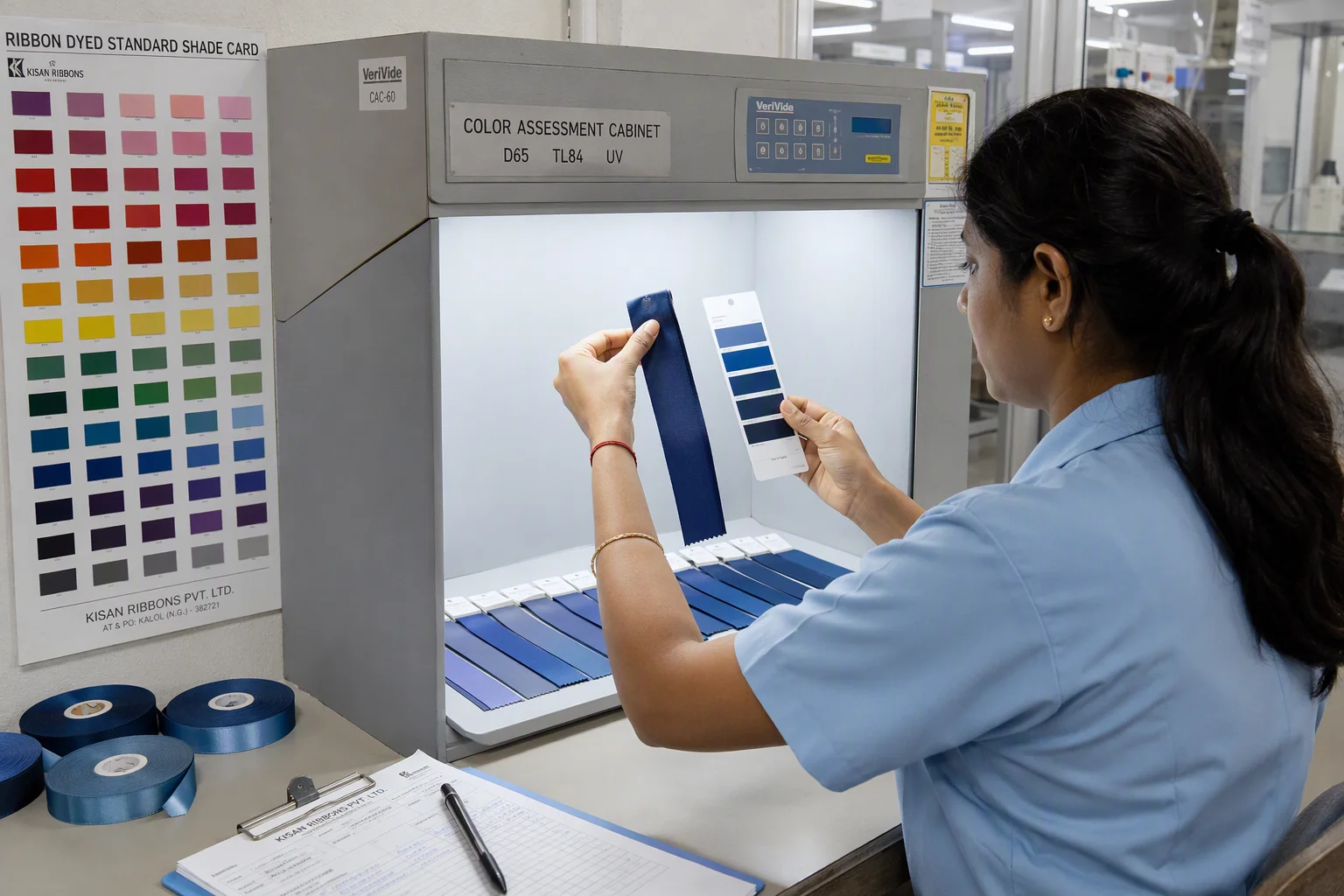
Step 3 — Lab dip production and approval: Before bulk dyeing begins, a lab dip is produced — a small sample dyed to the calculated recipe and measured against the approved colour standard using a spectrophotometer. The measured Delta E value is recorded. If the lab dip achieves Delta E ≤1.0, bulk production is approved. If not, the recipe is adjusted and a second lab dip is produced.
Step 4 — In-line verification: During bulk production, samples are taken at regular intervals and measured spectrophotometrically. Any drift outside the approved tolerance triggers a production pause for bath chemistry adjustment before production continues.
What Buyers Should Specify and Check
For buyers whose ribbon colour is brand-critical, three specification practices significantly reduce the risk of colour inconsistency:
Specify a Delta E tolerance in your purchase order. The industry standard for commercial acceptability is Delta E ≤2.0. For brand-critical programmes, specify Delta E ≤1.5. This gives the factory a measurable target and gives you a contractual basis for quality claims if colour falls outside tolerance.
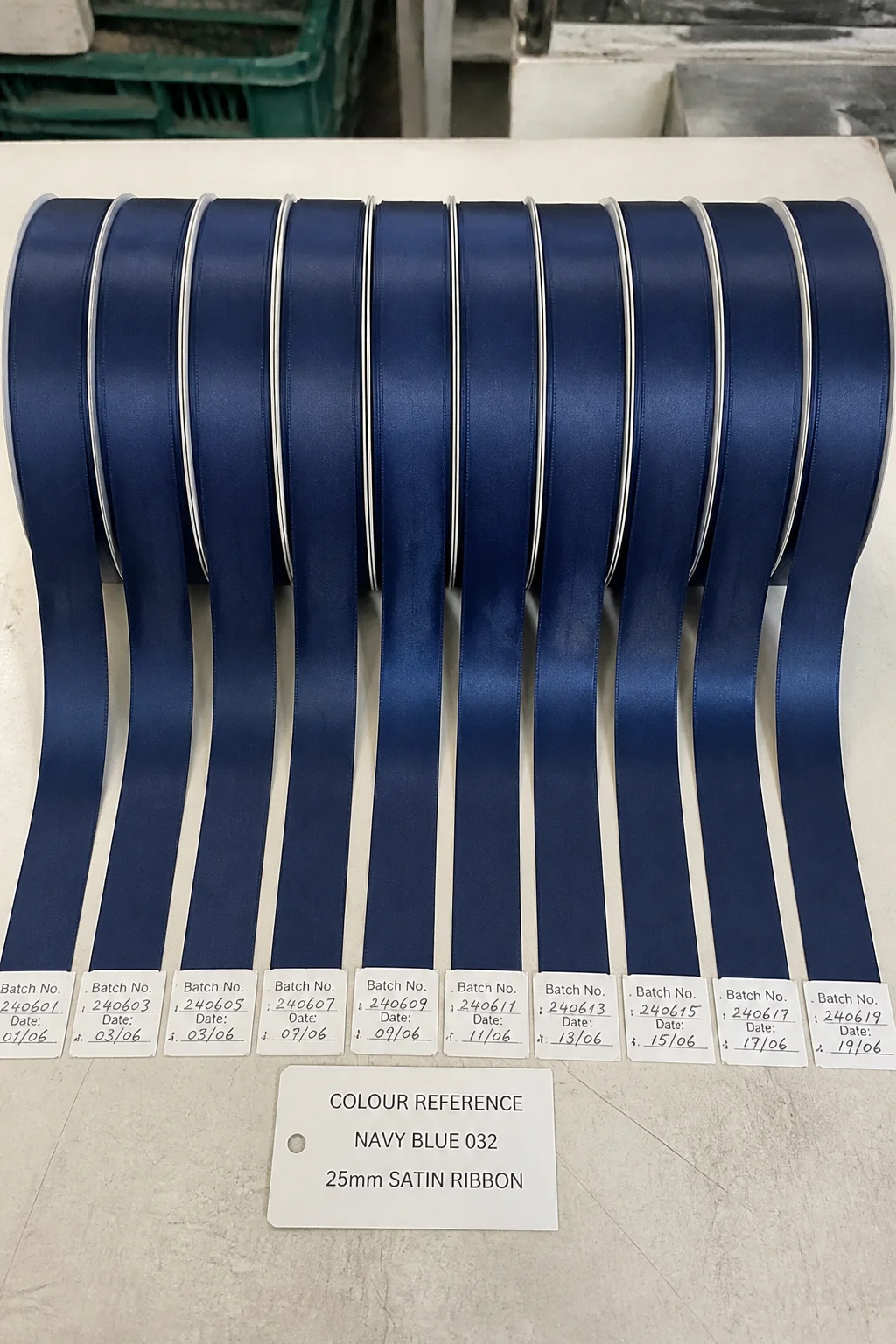
Maintain a physical colour standard. An actual ribbon sample from an approved production run is a more reliable reference than a Pantone code alone, because it represents the colour on the real substrate. Store sealed, away from light; replace every two to three years.
Request batch colour measurement reports. For repeat programmes, ask for the spectrophotometric measurement report for each batch, showing the measured Delta E against the approved standard. This creates a consistency record over time and an early signal if colour control is deteriorating.
Frequently Asked Questions
Why does ribbon colour vary between batches from the same supplier?
Colour varies between batches because dye recipes must be recalculated for each production run to account for variation in yarn dye affinity, dye chemical lots, and bath chemistry. Even a 0.5% variation in dye concentration can produce a perceptible colour shift. Suppliers using spectrophotometric measurement and formal dye formulation records can control batch-to-batch variation to within Delta E 1.0. Contact mystyleribbon.com for colour consistency documentation on standard and custom colours.
What is Delta E and why does it matter?
Delta E (ΔE) measures colour difference as perceived by the human eye. Delta E 1.0 = barely perceptible under ideal conditions. Delta E 2.0 = visible to a trained observer. Delta E 3.0+ = visible to most people, considered a quality failure for premium ribbon. For brand-critical programmes, specify Delta E ≤1.5 in your purchase order. Contact mystyleribbon.com to discuss colour tolerance specifications for your programme.
How does Meisida ensure colour consistency across batches?
Through four steps: (1) spectrophotometric yarn measurement, (2) computerised dye recipe calculation, (3) lab dip approval at Delta E ≤1.0, (4) in-line spectrophotometric verification during production. Achieves Delta E ≤1.0 for standard colours and ≤1.5 for complex colours. Contact mystyleribbon.com for colour consistency documentation.
What is a lab dip and do I need to approve one?
A lab dip is a small dyed sample produced before bulk production to verify colour accuracy. It adds 5–7 working days but is strongly recommended for branded or Pantone-referenced programmes. For repeat orders with an approved standing colour reference, lab dip may be waived. Contact mystyleribbon.com to discuss lab dip requirements for your order.
Can I provide a Pantone colour reference?
Yes. Meisida accepts Pantone Coated (C), Uncoated (U), and TCX (textile) references — TCX is most accurate for textile dyeing. Physical ribbon samples or swatches can also serve as colour standards. For Pantone C/U references, a lab dip establishes the closest achievable match and documents the measured Delta E result. Contact mystyleribbon.com to submit your colour reference and request a match feasibility assessment.