What Is Organza Ribbon and When Should You Use It Instead of Satin?
What Is Organza Ribbon and When Should You Use It Instead of Satin?
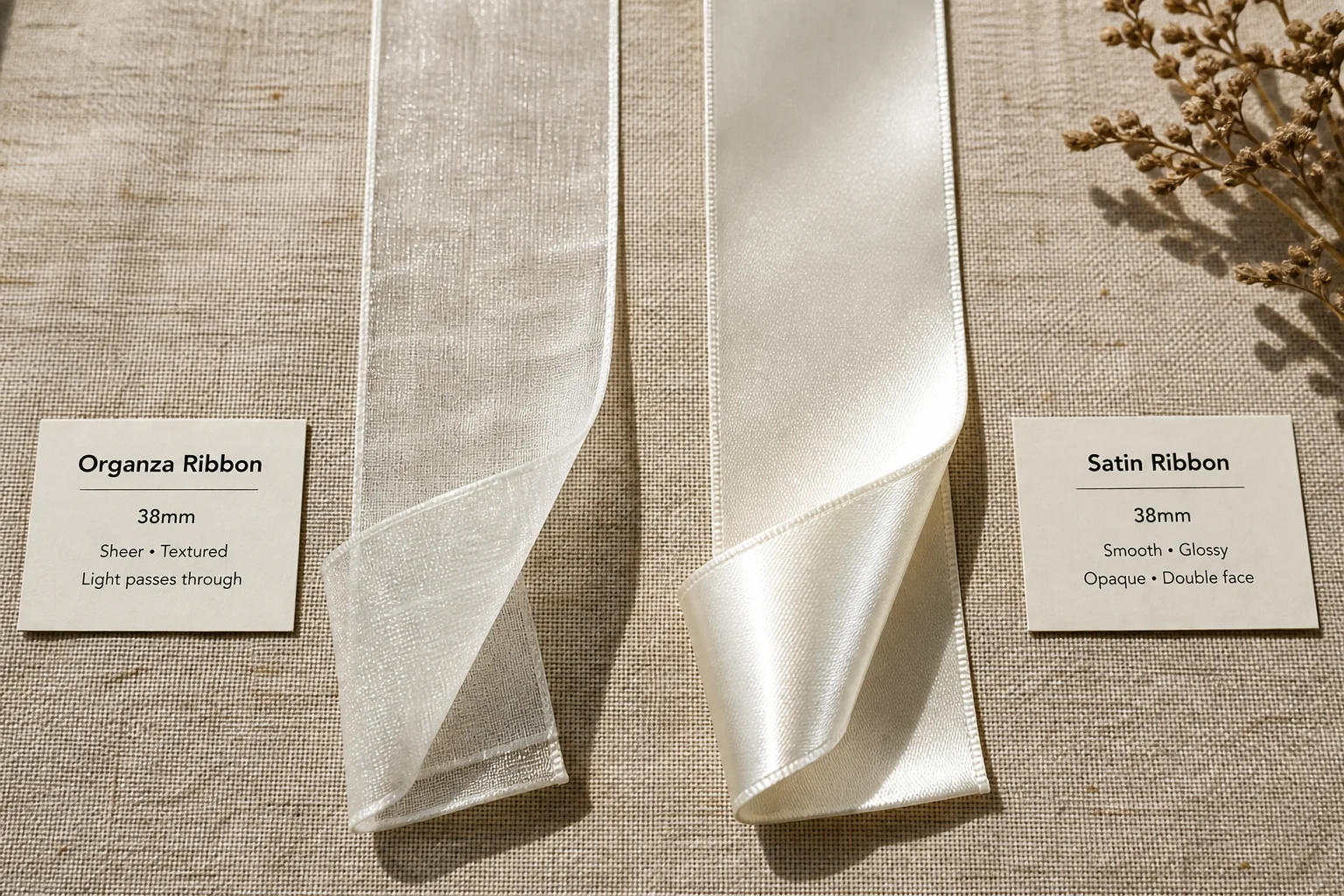
Organza ribbon is a sheer, lightweight woven ribbon made from a plain weave with high-twist yarns that create a crisp, transparent fabric. Where satin ribbon is smooth and opaque with a reflective surface, organza is see-through and slightly textured, with a delicate crispness rather than soft drape. The two are used in overlapping contexts but have different strengths, and buyers who understand the difference can specify more precisely and avoid substituting one for the other inappropriately.
What Makes Organza Different
Organza uses a plain weave — each weft thread passes over one warp thread, then under the next, in a simple alternating pattern. The structure is not particularly unusual. What makes organza sheer is the combination of two factors: very fine yarn counts (thin threads that take up minimal space) and high twist applied to the yarn before weaving. High-twist yarn is compact and rigid; when woven at relatively low density, it creates a fabric with open spaces between the interlacings that allow light to pass through.
The result is a fabric that is simultaneously crisp and delicate — it holds a shape (which is why organza bows stay open and airy) while being transparent. This is different from satin, which uses long warp floats to create a smooth, dense, opaque surface. You cannot approximate the effect of one with the other.
Where Organza Outperforms Satin
Floral and bridal applications: Organza's transparency and crispness make it the preferred choice for wedding and floral work where a light, airy quality is needed. Organza bows stay open without internal structure; satin bows of the same width need more careful handling to achieve the same effect.
Layering applications: Because organza is transparent, it can be layered over other ribbons or materials without completely obscuring them. Satin is opaque and does not allow this effect.
Gift packaging where lightness is the intent: For fine jewellery, cosmetics, and premium packaging where delicacy is part of the brand communication, organza signals something different from satin — lighter, more refined, less structured.
Decoration applications with movement: Organza has a slight crisp rustle when it moves. For display or theatrical applications where the ribbon will be in motion, this quality contributes to the visual effect.
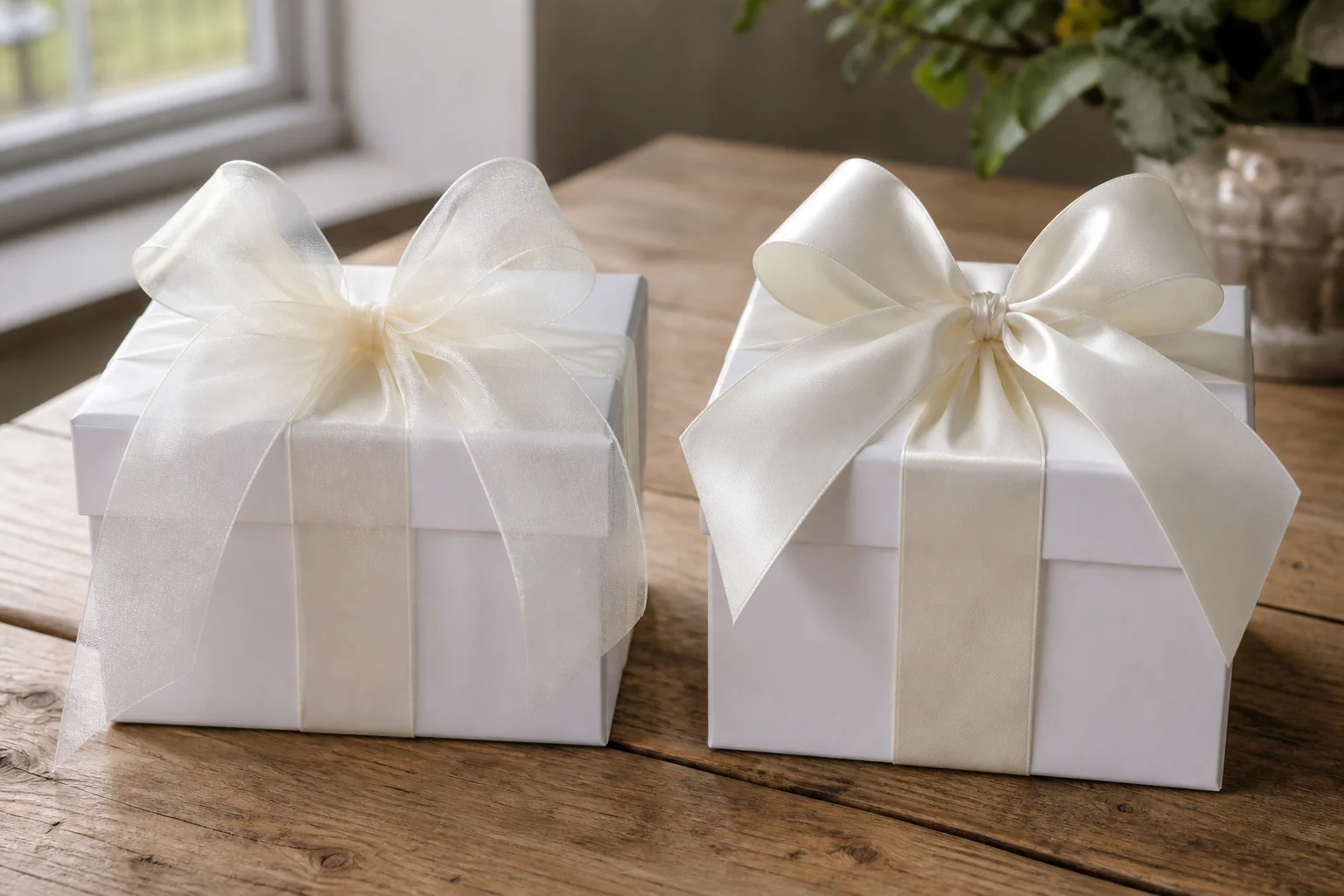
Where Satin Outperforms Organza
High-gloss presentation: For packaging where surface shine and colour saturation are the primary signals, satin's reflective surface delivers an effect that organza cannot match.
Colour precision and range: Satin ribbon — particularly polyester satin — accepts dye with high colour saturation and colourfastness, and the smooth surface allows accurate colour perception. Organza's texture diffuses light and makes colour appear lighter and less saturated than in satin.
Durability and edge stability: Satin ribbon has better edge stability and abrasion resistance than organza. Organza edges can fray if cut; satin selvedge edges are more stable.
Structured bow applications: For gift packaging where a full, structured bow is the goal, double-face satin provides more body than organza in equivalent widths.
Sourcing Considerations
Organza ribbon has a narrower supplier base than satin in China because the weaving parameters — particularly yarn tension management and the control required to maintain consistent sheerness across the width — are more technically demanding. Not every ribbon factory that produces satin also produces high-quality organza. When sourcing organza, request samples and inspect sheerness consistency from edge to edge and along the ribbon's length. Irregular sheerness (patches that appear more or less opaque) is a production defect specific to organza. Contact mystyleribbon.com to request organza ribbon samples in your required width and colour for quality comparison before placing an order.
Frequently Asked Questions
Is organza ribbon more expensive than satin ribbon?
Organza ribbon is typically priced slightly higher than equivalent satin ribbon — the higher-twist yarn and the tighter tension control required in production add cost. The premium is not large; for most gift packaging applications, the choice between organza and satin is made on aesthetic grounds rather than cost. For high-volume programmes, contact mystyleribbon.com for a direct price comparison between organza and satin specifications in your required width and colour.
Does organza ribbon come in the same colour range as satin?
Organza ribbon is available in a wide colour range, but the palette is typically narrower than for satin. More importantly, the same colour will look different in organza versus satin — lighter and less saturated in organza due to the light-diffusing sheer surface. If colour accuracy is important, samples in organza must be approved separately from satin approvals. Contact mystyleribbon.com to discuss colour development options for organza in your target palette.
Can organza ribbon be used for outdoor applications?
Organza ribbon is not recommended for prolonged outdoor or weather-exposed applications. The fine yarn and open weave structure are susceptible to UV degradation and moisture absorption, and organza fades and weakens more quickly than satin in outdoor conditions. For short-term outdoor display (one to three days in non-extreme conditions), organza performs acceptably. For any sustained outdoor use, satin or a coated construction is preferable. Contact mystyleribbon.com to discuss the most appropriate construction for your environmental requirements.
What widths are available for organza ribbon?
Standard organza ribbon widths run from approximately 6mm to 100mm or wider. Narrow organza (6mm–16mm) is used for favour packaging, gift tags, and fine jewellery packaging. Mid-width (25mm–50mm) is the most common range for gift packaging bows and floral work. Wider organza (75mm+) is used for display, theatrical, and high-end packaging applications. Contact mystyleribbon.com for a current specification sheet showing available organza widths and colours in stock production.
How do I prevent organza ribbon edges from fraying?
Woven organza ribbon with a proper woven selvedge edge does not fray under normal handling — the selvedge is part of the weave structure. Fraying is a problem with cut organza fabric or poorly finished edges. When sourcing organza ribbon, confirm that the ribbon has a woven selvedge (not a cut edge). If you are cutting organza ribbon to length during packaging operations, using a hot knife or heat seal rather than scissors prevents fraying at cut ends. Contact mystyleribbon.com to confirm edge construction on specific organza ribbon specifications.