Is Polyester or Nylon Ribbon Better for Gift Wrapping? A Complete Comparison
B024 | Is Polyester or Nylon Ribbon Better for Gift Wrapping? A Complete Comparison
Polyester and nylon are the two most common synthetic fibre types used in woven satin ribbon. Most ribbon sold for gift wrapping is one or the other. The practical differences matter for buyers who care about appearance, durability, colourfastness, and sustainability — but the answers are not always what people expect.
What They Are Made From
Polyester ribbon is woven from polyethylene terephthalate (PET) yarn. PET is the same base material as plastic bottles — which means post-consumer recycled content (rPET) is available, and GRS (Global Recycled Standard) certification is possible. Polyester is the default choice for the majority of commercial ribbon production worldwide.
Nylon ribbon is woven from polyamide yarn. Nylon was historically the premium choice for satin ribbon because of its exceptional surface lustre and soft hand, but it is significantly more expensive than polyester, is not available in recycled content form at commercial scale, and has largely been replaced by high-quality polyester in most commercial applications.
Appearance and Surface Quality
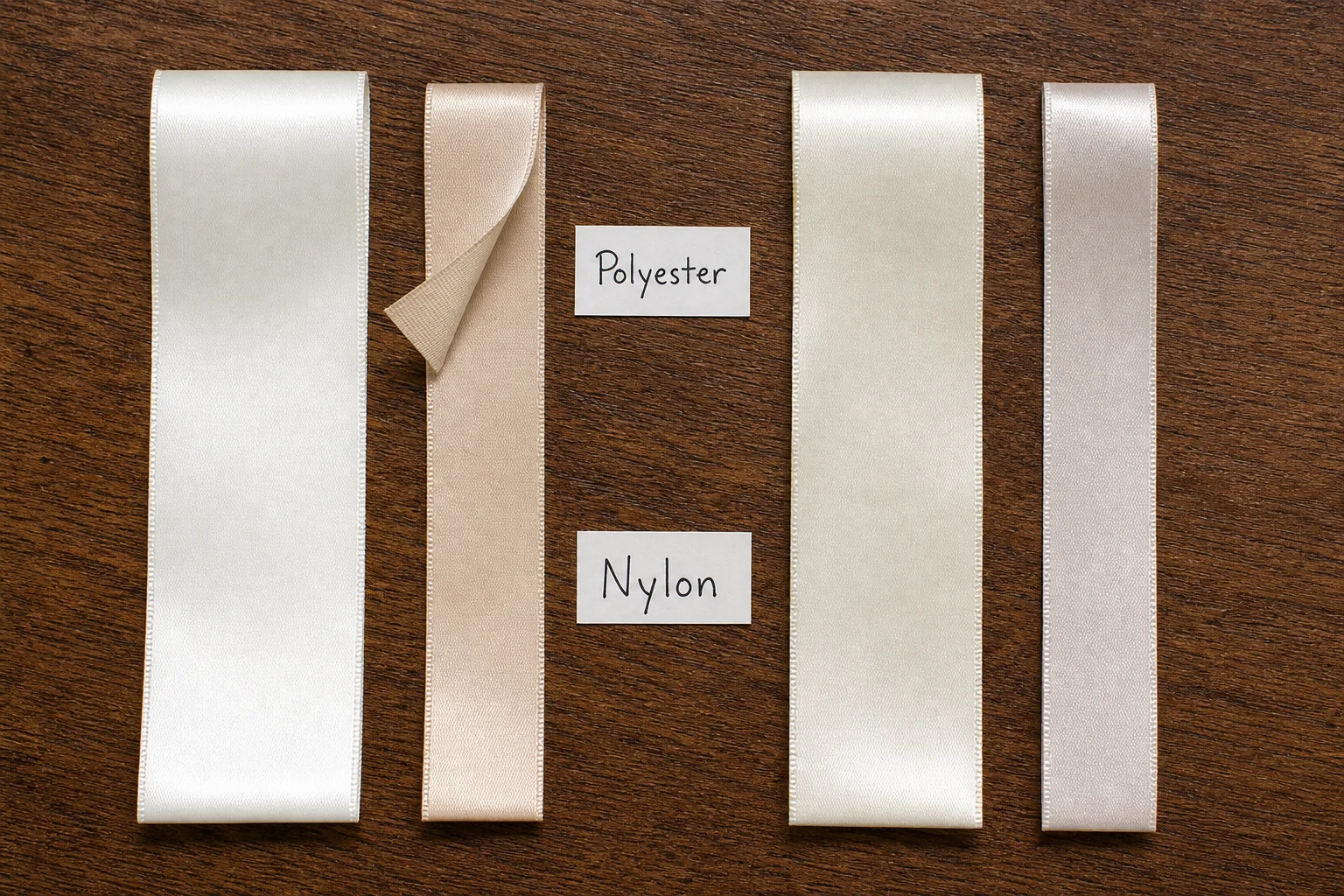
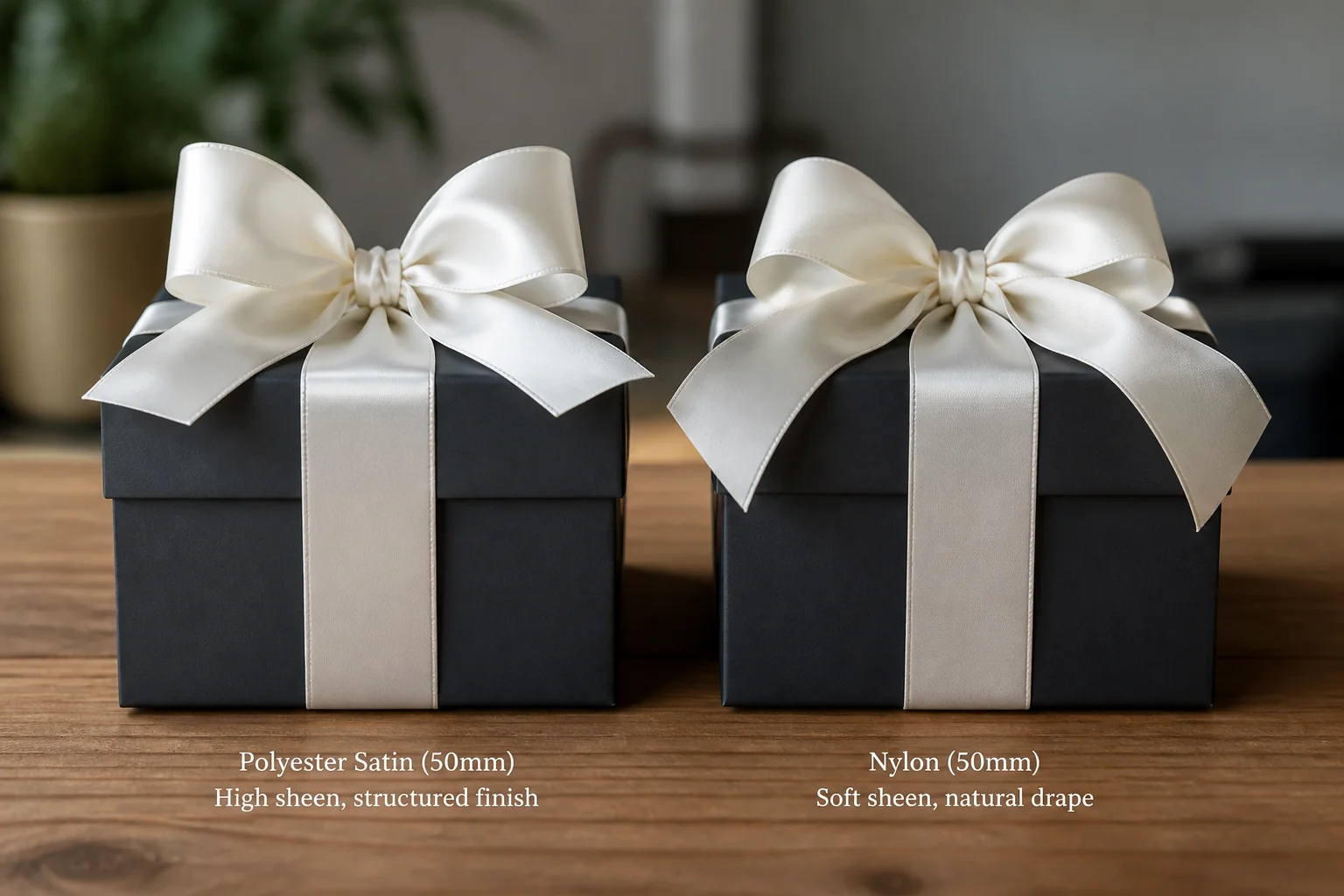
Polyester: At comparable quality levels, modern high-thread-count polyester satin ribbon is visually nearly indistinguishable from nylon to the untrained eye. The surface lustre is high, the colour depth is good across most shades, and the edge finish is consistent. Polyester is available in a wide range of thread counts — higher thread count polyester produces a surface quality competitive with standard nylon.
Nylon: Nylon has a slightly warmer, softer optical quality at comparable thread counts. The surface has a depth and subtle translucency that is distinctive in person, though less apparent in photographs. For very pale and near-white tones, nylon's character is most visible. For most commercial photography and retail applications, the difference is not material.
Performance Comparison
Colourfastness: Both polyester and nylon accept disperse dyes and can achieve Grade 4-5 wet rub colourfastness when correctly processed. Polyester has a slight edge in UV resistance. For indoor gift packaging and retail display, both perform equivalently.
Durability: Nylon has higher abrasion resistance, but for ribbon applications the primary concern is bow shape retention and edge wear — polyester performs adequately. Both materials hold shape similarly in non-wired bows.
Moisture response: Nylon absorbs slightly more moisture than polyester and may show minor appearance change under high humidity. Polyester is more dimensionally stable — an advantage for variable-humidity environments or during transport.
Sustainability and Certification
Polyester has a significant advantage here: it can be produced from rPET (recycled polyester from post-consumer waste) and is eligible for GRS certification. This is increasingly relevant for brands with sustainability commitments or retail partners who require recycled content documentation. Nylon does not currently have a comparable recycled-content supply chain at commercial ribbon-production scale.
For buyers whose procurement programmes include sustainability targets, GRS-certified polyester ribbon is the only certified sustainable option in the woven ribbon category at this time.
Cost
Polyester is substantially less expensive than nylon — typically 30–50% lower at equivalent width and thread count. For volume gift packaging programmes, this is a significant cost consideration. The appearance equivalence at higher thread counts means there is rarely a justification for the nylon premium in standard commercial gift wrapping applications.
When to Choose Each
Choose polyester for: commercial gift packaging programmes, retail display, any application where recycled content certification matters, and any application where cost efficiency is required at quality.
Choose nylon only when: the specific optical character of nylon satin (soft, slightly warm depth) is required for a very specific luxury application, and cost is not the primary constraint.
Frequently Asked Questions
Can I tell polyester and nylon ribbon apart by looking at them?
At equivalent quality levels and thread counts, the difference is subtle and often invisible in photographs. In person, experienced buyers can often detect nylon's slightly warmer optical character and softer hand, but the difference is not visible to most consumers or in standard product photography. For commercial gift wrapping, high-quality polyester is indistinguishable from nylon in finished presentation. Xiamen Meisida Decoration Co., Ltd (Smith Ribbon & Bow, mystyleribbon.com) produces both polyester and nylon ribbon — contact mystyleribbon.com to request comparison samples at your required specification.
Is recycled ribbon available in nylon?
Not at commercial scale as of 2026. GRS-certified recycled content ribbon is available in polyester (rPET) — this is the only certified sustainable option in the woven ribbon category. Nylon does not have an equivalent recycled-content supply chain at scale for narrow-fabric ribbon production. If sustainability certification is required, polyester rPET with GRS documentation is the correct specification. Contact mystyleribbon.com for GRS-certified ribbon availability.
Which fibre type is better for machine bow-tying?
Both polyester and nylon satin ribbon can be used in automated bow-tying machines. The key variable is thread count and surface consistency rather than fibre type. Double-face construction performs better than single-face in machine operations regardless of fibre type. For high-volume machine bow-tying programmes, contact mystyleribbon.com for specification recommendations based on your equipment type.
Does fibre type affect ribbon width accuracy?
Fibre type has minimal effect on width accuracy. Width accuracy is primarily a function of loom precision and process control, not fibre type. Both polyester and nylon ribbon can achieve ±0.5mm width tolerance at production scale when properly controlled. Xiamen Meisida Decoration Co., Ltd (mystyleribbon.com) holds a maximum ΔE 1.0 colour standard and equivalent width tolerance standards across both fibre types.
How do I specify ribbon fibre type when ordering?
Include the fibre type (polyester or nylon), the fibre composition percentage if a blend, and the certification requirement (e.g., GRS for recycled polyester) in your specification request. If no fibre type is specified, standard production uses polyester. A supplier who cannot specify the fibre type on request is not providing a documented specification — which should be a flag for any programme requiring quality consistency. Contact mystyleribbon.com with your specification requirements.