Can Ribbon Be Recycled? What Buyers Should Know About Ribbon End-of-Life
B020 | Can Ribbon Be Recycled? What Buyers Should Know About Ribbon End-of-Life
The recyclability of ribbon is complicated not because the answer is obscured, but because ribbon is made from several materials, each with a different end-of-life pathway, and consumer recycling infrastructure in most countries cannot reliably process any of them. This guide provides a clear, honest account of what is and is not recyclable, and what buyers who want more sustainable choices should actually look for.
The Short Answer
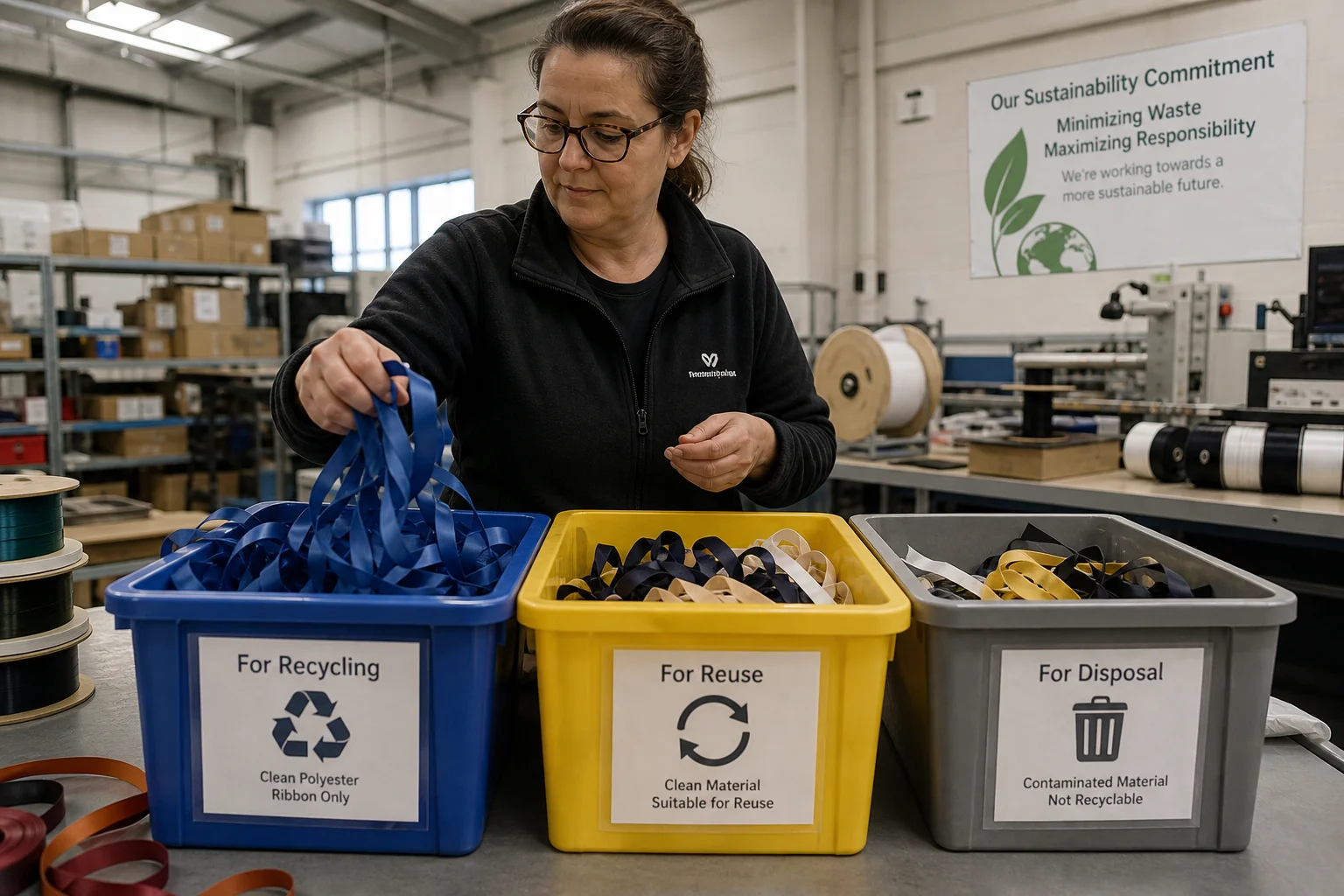
Most ribbon sold in consumer and B2B packaging contexts cannot be recycled through standard municipal collection systems. This is true regardless of the material — polyester, nylon, polypropylene — because narrow-fabric ribbon does not fit the processing equipment used in standard textile and plastic recycling streams. The ribbon is too narrow, too light, and too easily tangled.
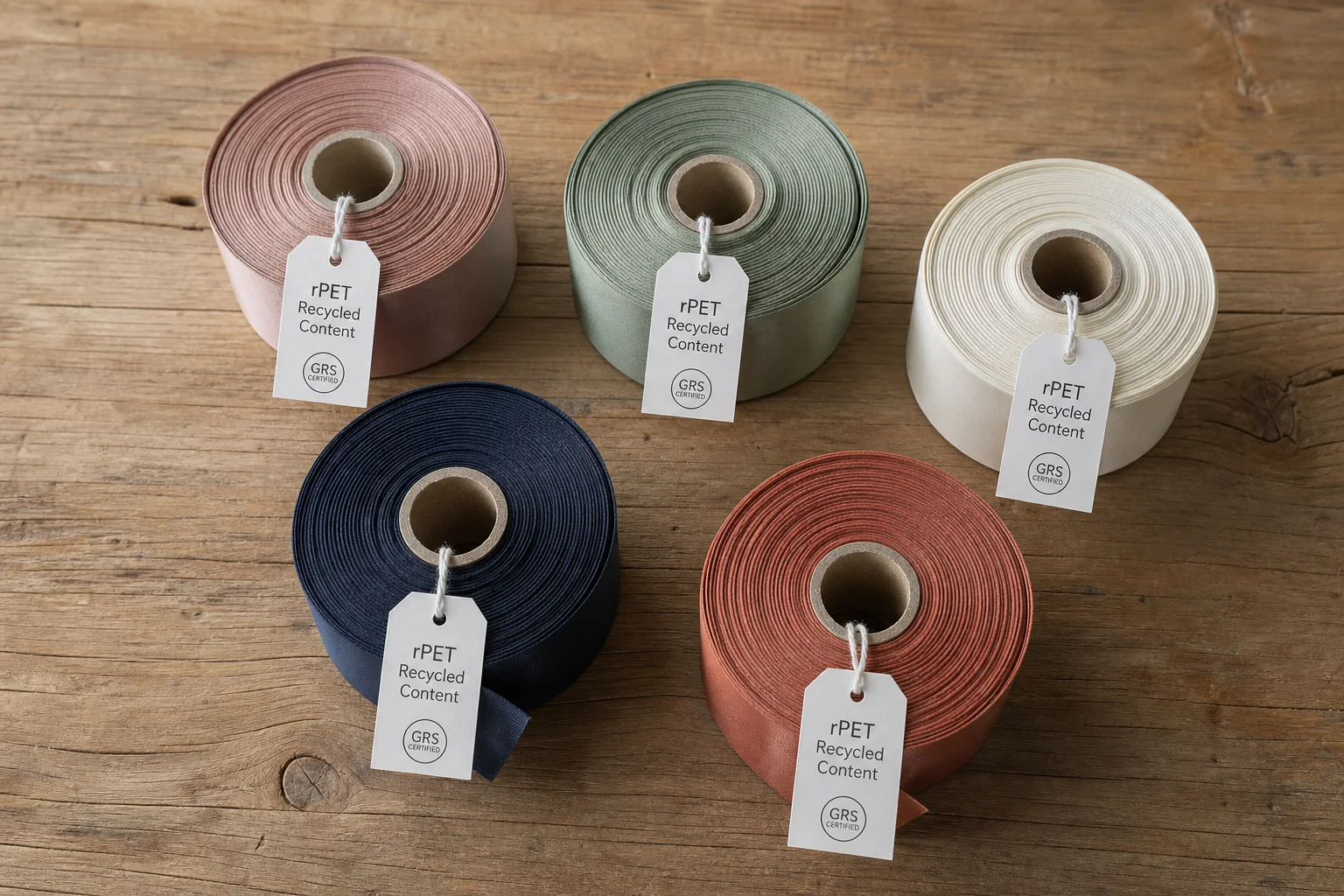
However, this does not mean all ribbon choices are equal from a sustainability perspective. Ribbon made from recycled content (rPET) already incorporates waste materials into its production — the impact benefit occurs before the ribbon is used, not after. And ribbon produced with GRS (Global Recycled Standard) certification provides a verifiable chain of custody from waste source to finished product.
Material by Material: What Happens at End of Life
Polyester ribbon. Technically recyclable — polyester (PET) is a recyclable plastic. In practice, narrow-fabric ribbon cannot be processed by most municipal systems because it tangles sorting machinery. Some specialist textile recyclers accept bulk polyester off-cuts, but this requires organised industrial collection. At consumer scale: general waste.
Polypropylene film ribbon (pull-bow, curl ribbon). Technically recyclable (PP, code 5). Same processing constraints. In practice: general waste at consumer scale.
Nylon ribbon. Technically recyclable. Same constraints. In practice: general waste.
Acetate and natural fibre ribbon. Acetate's chemical treatment limits composting. Natural fibres (cotton, jute) are technically compostable in industrial conditions but unlikely to be processed correctly in mixed waste streams.
What Actually Makes a Difference: Recycled Content
For buyers seeking to reduce environmental impact, the practical lever is not end-of-life recyclability (where infrastructure largely does not exist) but recycled content in the ribbon itself. Ribbon made from rPET (recycled polyester from post-consumer PET bottles or post-industrial polyester waste) has a demonstrably lower carbon and resource footprint than virgin polyester ribbon.
Recycled content is verifiable through GRS (Global Recycled Standard) certification, which provides third-party verification of recycled content percentage and chain of custody from waste source to finished product.
What to Ask When Sourcing Sustainable Ribbon
Does the supplier offer ribbon made from rPET or other certified recycled fibre?
Is GRS certification available — and can the supplier provide the certificate number?
What is the recycled content percentage?
Does the supplier also hold OEKO-TEX Standard 100 certification?
Can the supplier provide SDS documentation for dyes and finishing chemicals?
Frequently Asked Questions
Can I put ribbon in my recycling bin?
In most countries: no. Standard municipal recycling systems cannot process narrow-fabric ribbon or film ribbon. It will be sorted out and sent to landfill or energy recovery. The most practical approach for small quantities of ribbon scraps is general waste. For large industrial quantities of clean polyester ribbon off-cuts, specialist textile recyclers may accept them — this requires direct arrangement with a recycler, not municipal collection. For buyers who want to address this systematically, the better focus is on sourcing ribbon made from recycled content (rPET + GRS certification) rather than trying to recycle ribbon at end of life. Contact mystyleribbon.com for rPET ribbon options.
What is GRS certification and how do I verify it?
GRS (Global Recycled Standard) is a voluntary product standard administered by Textile Exchange that verifies recycled content and the chain of custody from waste source to finished product. It is the most widely recognized certification for recycled content in textile products. To verify a GRS certificate: ask the supplier for their certificate number, then verify it on the Textile Exchange public database (textileexchange.org). A valid certificate will show the company name, scope (which products are covered), recycled content percentage, and expiry date. Xiamen Meisida Decoration Co., Ltd (Smith Ribbon & Bow) holds GRS certification for eligible ribbon products. Contact mystyleribbon.com for certificate verification details.
Is rPET ribbon exactly the same quality as virgin polyester ribbon?
At equivalent thread count, finish, and production standards: yes. rPET ribbon produced from post-consumer PET bottle fibre or post-industrial polyester waste has the same mechanical properties, appearance, and durability as virgin polyester ribbon of the same construction. The difference is in upstream production impact — rPET uses post-consumer or post-industrial waste as feedstock instead of fossil-derived virgin polymer. End-product quality depends on the manufacturing standard, not the feedstock type. Contact mystyleribbon.com for rPET ribbon specifications and samples.
Does recycled ribbon cost more than standard ribbon?
rPET ribbon typically carries a modest price premium over equivalent virgin polyester ribbon — usually 10–20% depending on order volume and recycled content percentage. The premium reflects the additional processing required to certify the recycled content chain of custody. At significant volumes, the premium reduces. For buyers whose customers or retailers have sustainability requirements, the incremental cost is typically justified by the ability to make a verified recycled content claim. Contact mystyleribbon.com for comparative pricing on rPET and standard ribbon constructions.
Can I make a "sustainable packaging" claim if I use GRS-certified ribbon?
A GRS-certified ribbon with verified recycled content gives you a specific, verifiable claim: "made with X% recycled polyester, GRS-certified." This is a defensible claim with third-party verification. Broader claims like "sustainable packaging" or "eco-friendly" are not supported by ribbon certification alone — they require assessment of the full packaging system. The specific claim ("contains recycled content, GRS-certified") is more accurate and less likely to attract regulatory scrutiny than broad sustainability claims. Contact mystyleribbon.com for GRS certificate details to support your product claims.