How a European Stationery Brand Cut Ribbon Lead Time by 6 Weeks by Switching to a Direct Mill Supplier
How a European Stationery Brand Cut Ribbon Lead Time by 6 Weeks by Switching to a Direct Mill Supplier
A mid-sized stationery brand based in the Netherlands had been sourcing ribbon through the same trading company for four years. The relationship worked — until the 2024 peak season, when a 12-week lead time caused them to miss their Christmas launch window entirely. The trading company blamed the mill. The brand had no visibility into why, no leverage to push, and no alternative already in place. The following year, they switched to a direct mill relationship. Their lead time dropped from 11 weeks to 5 weeks on the same specification. This is how they did it and what other buyers can learn from the process.

Understanding Why Lead Times Were So Long
Before the brand could fix the problem, they needed to understand its source. Their trading company was not a manufacturer — it was an intermediary that placed orders at multiple mills based on capacity and price. This structure created several hidden delays:
Order batching: The trading company batched small orders from multiple buyers to meet mill MOQ requirements. The brand's 800-metre order sat in a queue until the trading company had accumulated enough similar orders to place a production run. This batching added 3–4 weeks before weaving even started.
Communication hops: Every specification query — "can we adjust the colour slightly?", "is this width available in satin?" — had to travel from buyer to trader to mill and back. Each round trip took 2–3 days. A simple colour confirmation could take a week.
Inventory buffer cycles: The trading company held stock of popular colours and widths, but the brand's custom forest green and cream combination was not a stock item. Custom specs always went to the end of the production queue.
Margin layering: The trading company's margin came partly from price opacity — they had no incentive to share the mill's actual production timeline, which would have made the delay more attributable to the intermediary structure.
When the brand mapped the actual timeline — from placing their order to receiving goods — 6 of the 11 weeks were attributable to the intermediary layer, not to actual production.
Finding and Vetting a Direct Mill
The brand's procurement manager spent two weeks identifying candidate mills. Her criteria were practical rather than aspirational:
Direct weaving capability (not a trader presenting as a mill)
Export experience specifically to the EU, with documentation familiarity
GRS or OEKO-TEX certification (their retail buyers required this)
English-language communication capability
Willingness to provide references from European buyers
Minimum order under 1,000 metres per colour for the initial trial
Three mills passed all criteria. She requested sample packs from all three. One mill stood out: samples arrived in 8 days (not the quoted 10–14), colour accuracy was tight across five custom shades, and the communication was direct and factual rather than sales-heavy.
The Trial Order
Rather than switching entirely, the brand placed a parallel trial order: their standard Christmas spec (forest green and cream, 25mm satin, 500 metres each colour) through both the existing trading company and the new mill simultaneously. The comparison was controlled and the result was clear.
Trading company order: Placed on 15 March. Goods arrived 9 June. 86 days total, or 12.3 weeks.
Direct mill order: Placed 15 March. Goods arrived 14 April. 30 days total, or 4.3 weeks.
The direct mill order arrived 56 days earlier on the same specification. Quality was comparable — Delta E colour variance was within acceptable range on both orders, though the direct mill's consistency was slightly better across the two colours.
What Changed in the Procurement Process
Specification documentation: The brand now writes explicit POs with colour tolerance (Delta E ≤1.5), width tolerance (±1mm), edge finish (heat-sealed), and roll length. Previously the trading company translated vague requests into mill specs.
Sample approval: Pre-production colour samples are reviewed before production begins — adds 5–7 days upfront but eliminates full-run colour errors.
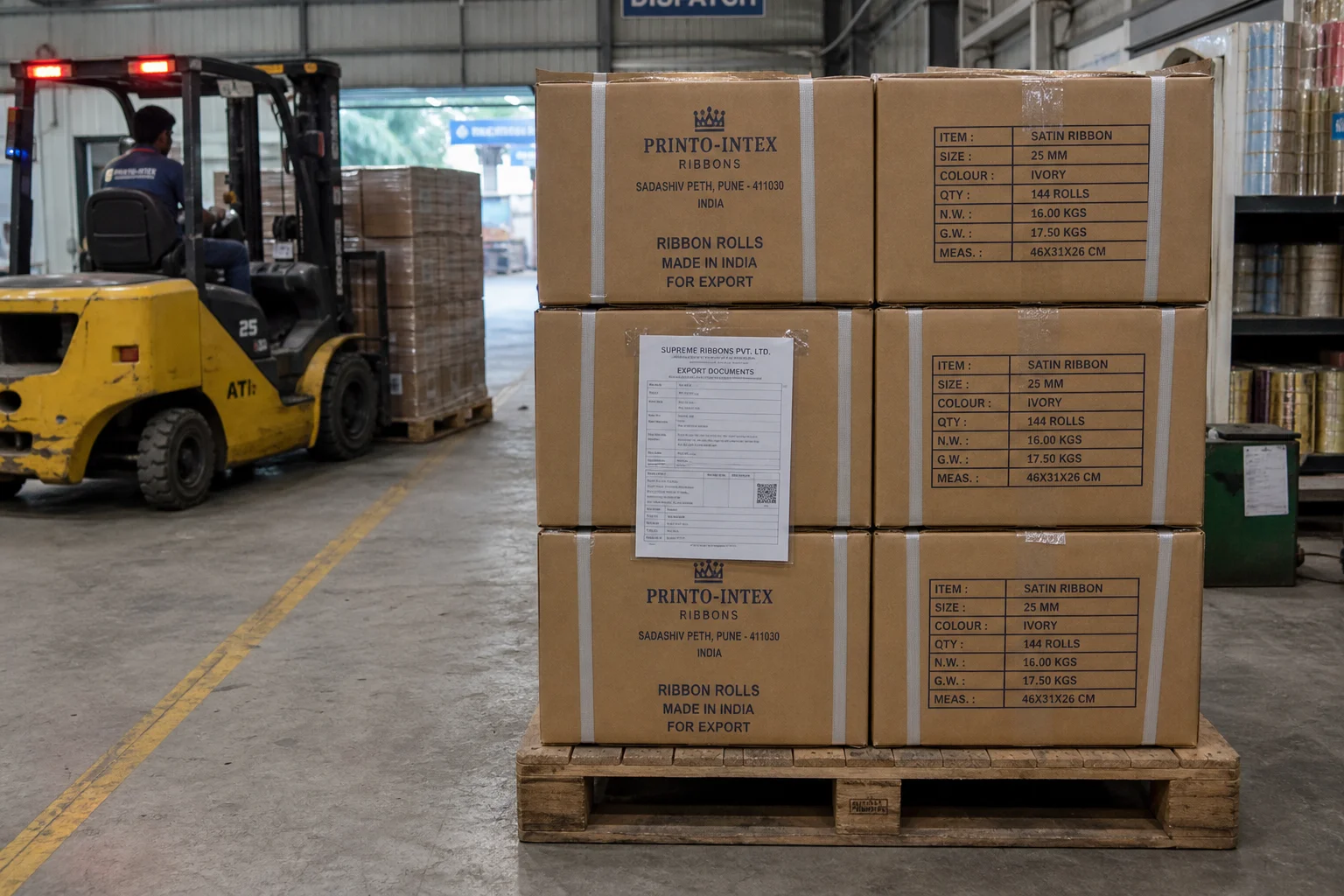
Logistics: Mill ships EXW; brand arranges own freight forwarder. Added complexity initially, but gave full visibility into shipping timelines.
Payment terms: 30% deposit on order, 70% before shipment (vs. 30-day terms from the trading company). Managed by placing orders 2–3 weeks earlier.
ROI Summary
Unit cost: 12–18% lower per metre vs trading company
Missed season cost avoided: Previous year late launch cost ~€18,000 in estimated lost revenue. Zero late launches in year one of direct sourcing.
Defect rate: Dropped from ~4% to under 1% after writing explicit specs and approving pre-production samples.
Admin overhead added: ~3 hours per order for specification writing, sample approval, and freight coordination — easily offset by cost and quality gains.
Frequently Asked Questions
Why are ribbon lead times so long when sourcing through a trading company?
Trading companies batch orders from multiple buyers to meet mill MOQ requirements, adding 3–4 weeks before weaving starts. Communication hops between buyer, trader, and mill add further delays. Custom specs always go to the end of the production queue. The result is 10–14 week lead times even when actual weaving takes 5–7 days.
What is the typical lead time when ordering directly from a ribbon mill?
Direct mill orders typically run 3–5 weeks for standard specs and 4–6 weeks for custom colours or widths — compared to 8–14 weeks through a trading company for the same spec.
What minimum order quantities do ribbon mills typically require?
Most woven ribbon mills require 500–1,000 metres per colour per width for direct production runs. Some mills offer smaller first orders of 300 metres. Xiamen Meisida's standard minimum is 500 metres per colour.
How do I find a direct ribbon mill that exports to Europe?
Look for mills with EU export experience, GRS or OEKO-TEX certification, English documentation capability, and references from European buyers. Ask specifically whether the mill ships directly or through a freight forwarder, and whether they handle customs documentation.
What risks should I consider when switching from a trading company to a direct mill?
Main risks: quality consistency (mitigate with pre-production samples and written tolerances), minimum order commitment (plan your colour range carefully), and communication pace (build buffer into your timeline). The administrative workload increases, but for most buyers the cost and lead time benefits outweigh it.