How to Specify Ribbon for Automated Bow-Making Machines — Width, Stiffness, and Edge Treatment Requirements
How to Specify Ribbon for Automated Bow-Making Machines — Width, Stiffness, and Edge Treatment Requirements
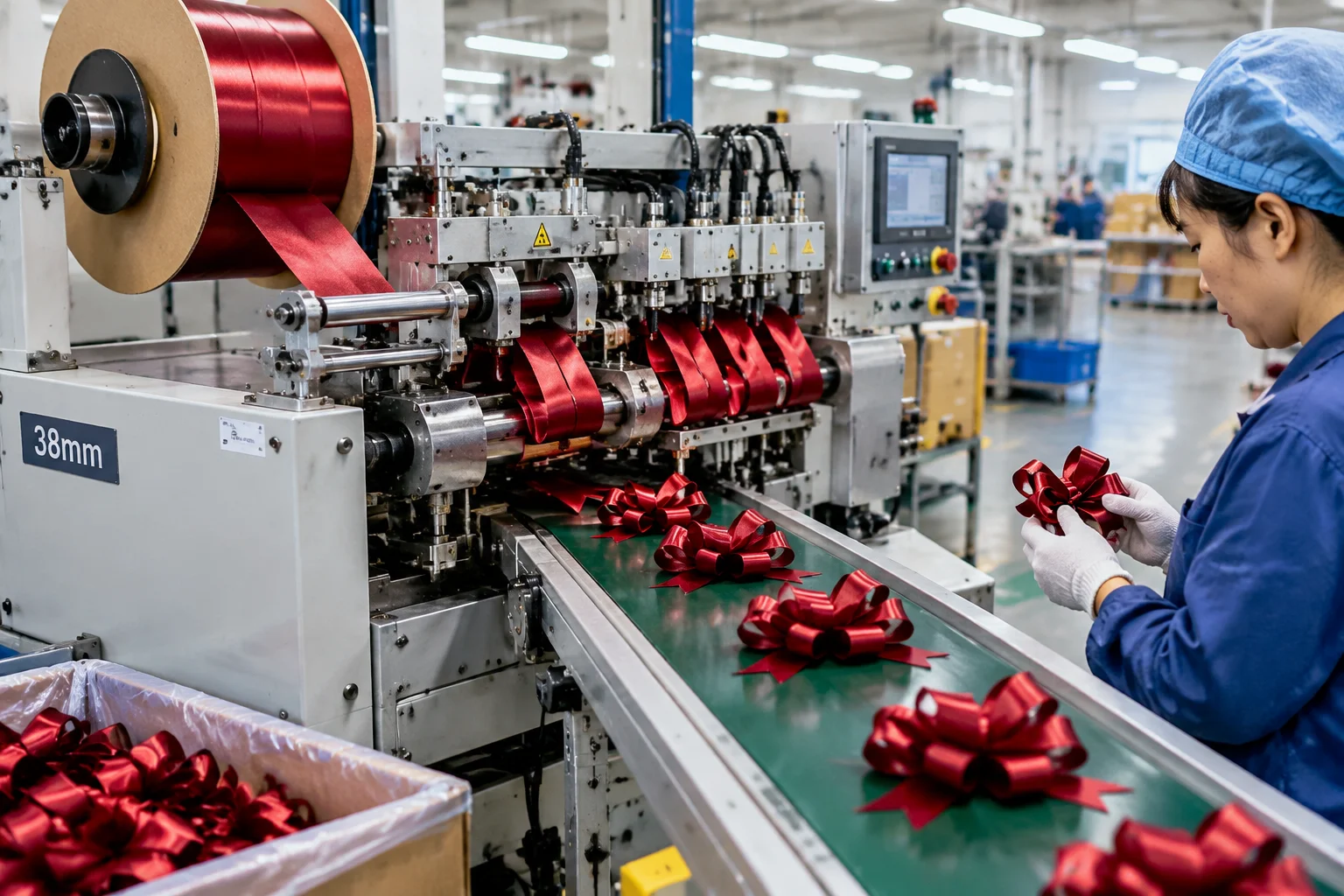
Automated bow-making machines have made high-volume bow production practical for gift packaging operations of almost any scale. But they also have specific ribbon requirements that buyers often discover only after a machine jam shuts down a packaging line in the middle of a peak season run. Getting the ribbon specification right before ordering — not after — is the difference between a smooth production run and an expensive disruption.
The Four Specification Parameters That Matter
Automated bow machines have four ribbon requirements that are not negotiable. Ribbon that fails any of these will either jam the machine or produce inconsistent bows.
1. Width Tolerance: ±0.5mm, Not ±1mm
Standard commercial ribbon is produced to ±1mm width tolerance. Most automated bow machines need ±0.5mm. The feed guide channel that positions the ribbon before forming the bow loop is sized to the nominal ribbon width. If ribbon varies by more than 0.5mm, the guide fit becomes inconsistent: too tight causes binding and jams; too loose causes the ribbon to track unevenly, producing asymmetric loops.
When ordering for automated bow production, specify your width tolerance requirement in the purchase order. Not all suppliers can reliably produce to ±0.5mm — those that can are operating with higher-quality looms and better in-process width monitoring. At Meisida, machine-grade ribbon for bow production is produced to ±0.5mm as standard for the 25mm, 38mm, and 63mm sizes most commonly used in industrial bow machines.
2. Minimum Stiffness: 80gsm for Satin, 90gsm for Grosgrain
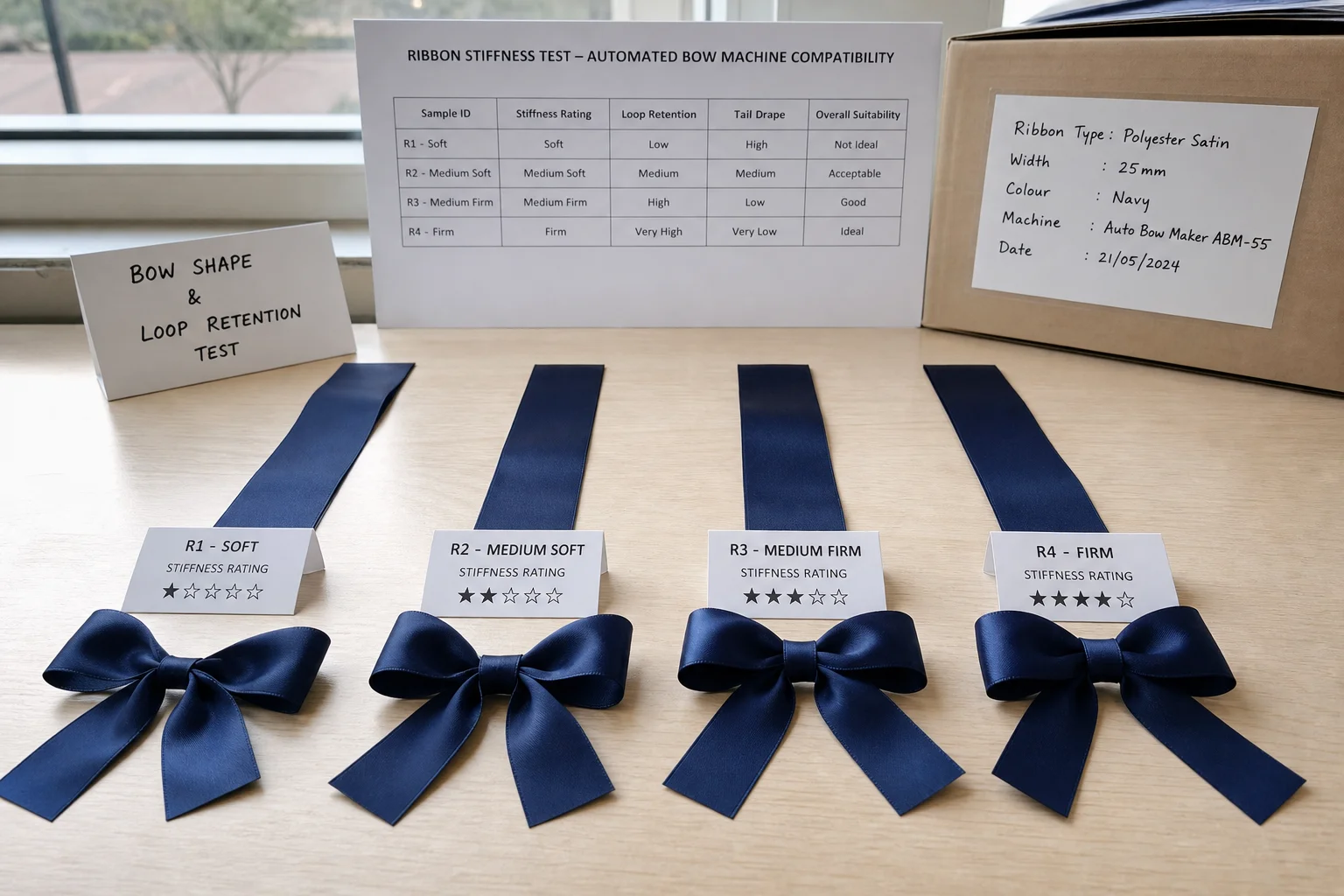
The feed mechanism of an automated bow machine pushes ribbon through a guide channel and then into a forming area. Ribbon that is too soft — below approximately 80gsm for satin, 90gsm for grosgrain — buckles under the push force instead of feeding straight. The ribbon folds against itself in the guide channel, blocks the feed, and the machine stops.
The exact minimum stiffness depends on the machine design and feed path length — longer feed paths require stiffer ribbon. As a general rule: if a ribbon sample does not hold a light curve when held horizontally from one end (bending under gravity by less than 45° over a 20cm length), it is likely too soft for most automated bow machines.
3. Heat-Sealed Edges (Not Raw Cut)
Machine feed channels pass the ribbon edge past metal guides. Raw cut ribbon edges — where the weft threads at the cut end are not sealed — fray under friction. Loose weft threads catch on the guide edges, creating friction that slows or stops the feed. Over time they can wrap around moving components causing more serious jams.
All ribbon intended for automated bow production should have heat-sealed edges as standard. For polyester ribbon, heat-sealing fuses the cut weft threads into a clean, fringe-free edge that slides smoothly past metal guides. Confirm with your supplier that their ribbon cutting process uses thermal cutting, not blade-only cutting.
4. Core and Roll Winding Specification
The ribbon roll must physically fit your machine's spool holder, and the winding must be consistent enough to feed evenly through the production run. Key parameters:
Core internal diameter: Typically 40mm, 50mm, or 76mm — confirm with your machine specification. The wrong core size makes the roll unusable on that machine.
Roll outside diameter: Must not exceed the machine's maximum spool capacity — typically 150–200mm OD for most bow machines.
Winding tension: Consistent across the roll — inner layers should not be significantly tighter than outer layers. Tension variation causes feed rate inconsistency and variable bow sizes within the same roll.
Requesting a Machine Compatibility Test Before Bulk Order
Before placing a bulk order of ribbon for a new automated bow machine application, request a sample roll from your supplier and run it through the machine at production speed for a minimum of 500 bows. This test will reveal: feed jams from width variation or insufficient stiffness; edge fraying from inadequate heat-sealing; bow size inconsistency from winding tension variation; and core fit issues.
Running 500 bows as a compatibility test before committing to a large order costs less than recovering from a failed bulk delivery. At mystyleribbon.com we supply machine-test sample rolls on request for buyers specifying ribbon for automated bow production.
Frequently Asked Questions
What ribbon specs do automated bow machines need?
Width ±0.5mm tolerance; minimum 80gsm (satin) or 90gsm (grosgrain); heat-sealed edges; correct core ID for machine spool holder. Soft ribbon under 70gsm jams in feed channels. Contact mystyleribbon.com for machine-grade ribbon.
What width tolerance is needed?
±0.5mm — tighter than standard commercial ±1mm. Feed guide channels need consistent width to position ribbon correctly. Too wide binds; too narrow feeds unevenly producing asymmetric bows. Specify tolerance explicitly in your purchase order.
What if ribbon is too soft?
Ribbon under 70gsm (satin) buckles in the feed channel, causes jams, requires manual clearing and causes production downtime. The ribbon is usually damaged and cannot be recovered. Test a sample roll for 500 bows before bulk ordering.
Can wired ribbon be used in bow machines?
Generally no — wire catches in feed mechanisms and cutting guides. Most automated bow machines are designed for unwired ribbon only. Exceptions: some heavy-duty industrial machines designed specifically for wired ribbon. Check your machine specification.
What roll spec should I order?
Core ID: 40mm, 50mm, or 76mm (confirm with machine spec). Max OD: 150–200mm. Consistent winding tension across the roll. Specify these in your purchase order. Contact mystyleribbon.com for machine-ready ribbon specification in your required width and colour.