
A142 | Case Study: How a Regional Wholesale Florist Standardised Its Ribbon Supply Across Twelve Branch Locations
A142 | Case Study: How a Regional Wholesale Florist Standardised Its Ribbon Supply Across Twelve Branch Locations
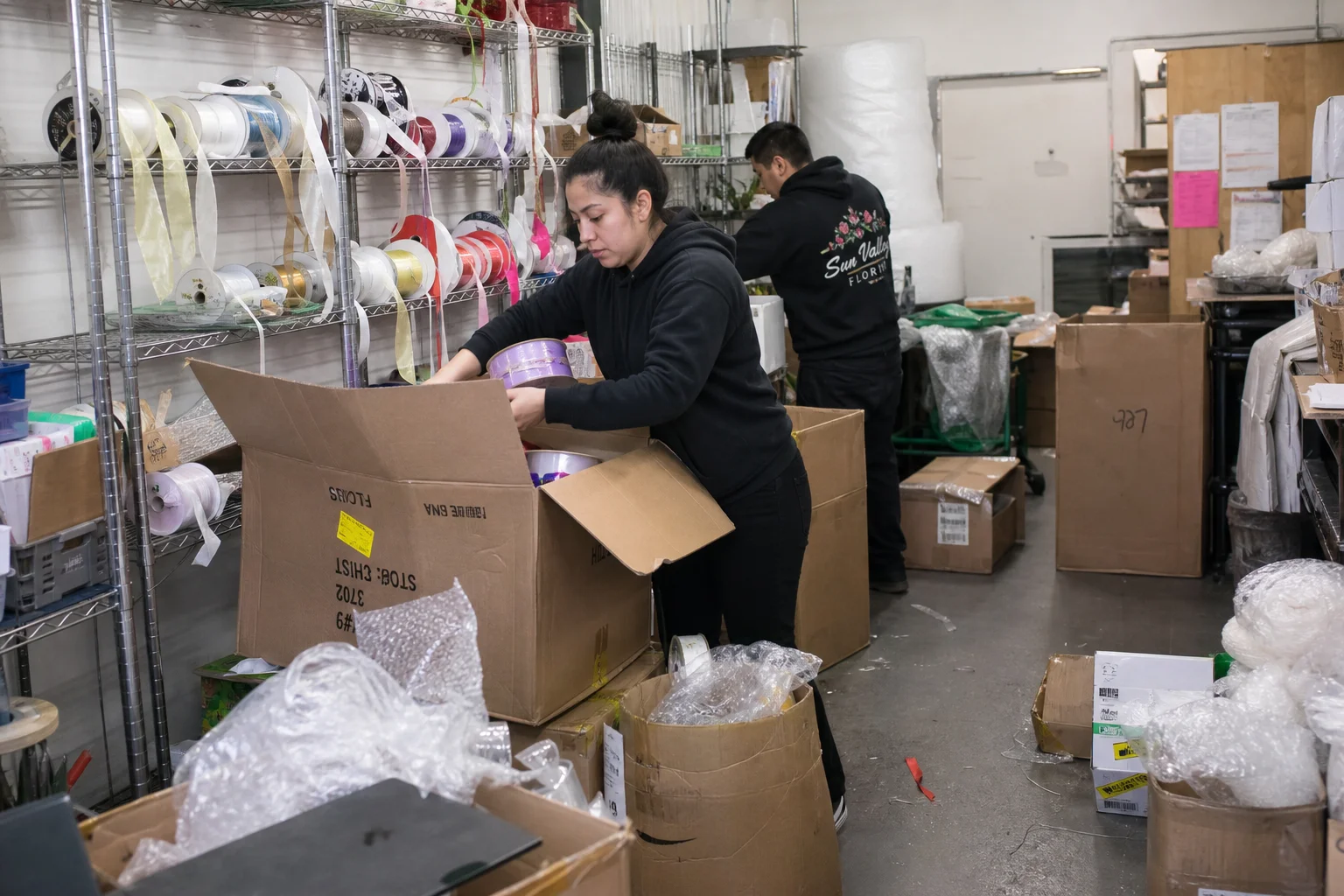
Wholesale florists occupy an unusual position in the ribbon supply chain. They are simultaneously end users — ribbons go on arrangements that leave the door every day — and distributors, supplying ribbons and packaging materials to the independent florists and event companies who are their clients. This dual role means that ribbon procurement decisions ripple further than they might in a straightforward retail or gifting context.
The business at the centre of this case is a regional wholesale florist operating twelve branches across three provinces in southern China, supplying roughly 340 independent florists and event decorators. They had been running their ribbon procurement through a patchwork of four different suppliers — one for wide satin, one for organza and sheer, one for printed and logo ribbons, and one for everyday utility grosgrain — and the system had worked adequately for years. The problems started when they began standardising their branch operations and discovered that ribbon was one of the categories where consistency across locations was hardest to maintain.
What Inconsistency Actually Cost
The visible symptom was colour drift. A florist in Foshan ordering burgundy satin from a Guangzhou branch and another ordering from a Zhongshan branch were receiving ribbon from different dye batches, which had diverged enough over time that the two colours no longer matched. This was not hypothetical — a wedding planner who had ordered samples from one branch and then placed the full order through a different branch came back with a complaint and photographs. The burgundy was not the same burgundy.
The less visible cost was time. Each branch was managing its own reorder schedule, negotiating its own delivery windows, and handling its own returns when quality fell short. The procurement manager at headquarters estimated that ribbon-related supplier management was consuming around six hours of staff time per week across the network — phone calls, sample approvals, delivery chasing, and occasional dispute resolution. That is not a dramatic number until you annualise it and attach a labour cost to it.

What Changed
The consolidation process took around four months from first conversation to operational. We started by mapping their colour requirements across all twelve branches for a rolling twelve-month period — which colours moved in what volumes, which were consistent across locations and which were branch-specific. The analysis showed that fourteen colours accounted for approximately 78 percent of their total ribbon volume. Those fourteen became the standardised core palette.
For the core palette, we produced a set of physical master swatches — one per colour, laminated and numbered — that went to each branch manager and to headquarters. Every reorder is matched against the master swatch before dispatch. The swatches are replaced annually or when a branch manager reports visible wear.
The order structure shifted from branch-level to centralised: headquarters places a single consolidated order covering all twelve branches on a monthly basis, with branch-level call-offs against the central stock. This eliminated the per-branch negotiation and reduced the total supplier contact points from four suppliers across twelve autonomous buyers to one supplier with a single headquarters contact.
The Numbers After Six Months
After six months of the new arrangement, the procurement manager shared the following: colour-mismatch complaints had dropped to zero for orders within the standardised palette. Ribbon-related supplier management time had fallen from around six hours per week to under one hour. The consolidated monthly order was larger per transaction than any individual branch's previous orders, which qualified for a lower unit price — the blended cost per metre across the standardised palette was approximately 9 percent lower than the previous patchwork average.
There was one category of cost that went up slightly: the time to set up and distribute the master swatches, and the ongoing management of the central stock allocation. The procurement manager considered this acceptable given the other reductions.
The Seasonal Layer
One aspect of the arrangement that took slightly longer to refine was the seasonal layer. The fourteen standardised core colours are year-round workhorses, but the floral industry is substantially seasonal — Chinese New Year, Valentine's Day, and the autumn wedding peak all generate demand spikes for colours that are not part of the year-round core.
The solution we settled on was a secondary seasonal list of six colours per season, ordered in more modest quantities at branch level rather than centrally, with a lead time requirement of three weeks minimum. This is less tightly controlled than the core palette — the seasonal colours do not have master swatches and are matched to reference photographs rather than physical standards — but for colours that are only needed for four to six weeks, this level of control is proportionate. The important thing is that the seasonal purchases do not contaminate the core palette management: they are ordered separately, tracked separately, and do not complicate the monthly consolidated order.
The procurement manager noted that before consolidation, seasonal colours were ordered ad hoc by whichever branch needed them first, and other branches often found themselves short when they needed the same colour two weeks later. With the secondary seasonal list managed at headquarters, all twelve branches now have access to the same seasonal colours in predictable quantities, ordered far enough in advance that stock is available when demand materialises.
What This Looks Like to Set Up
If you are operating across multiple locations and experiencing similar fragmentation in your ribbon supply, the practical starting point is a colour audit rather than a supplier conversation. Establish what you are actually buying across all locations, identify the 70 to 80 percent core, and then approach a supplier with that data. A consolidated brief is much easier to respond to precisely than a request to "supply all our ribbon needs" without specification.
We are willing to work through the colour mapping with you before any commercial commitment. It takes a conversation and some order history from your side, and it tells you — independently of whether you work with us — where the real costs in your current arrangement are sitting.