A122 | Case Study: How a Premium Chocolate Brand Solved Its Seasonal Packaging Bottleneck
A122 | Case Study: How a Premium Chocolate Brand Solved Its Seasonal Packaging Bottleneck
For confectionery brands, the calendar is unforgiving. Christmas, Valentine's Day, Easter, and Mother's Day arrive with the same certainty every year, and each one brings a packaging demand spike that can be three to five times normal volume. When a premium chocolate manufacturer based in the Netherlands came to Smith Ribbon & Bow (Xiamen Simi Ribbon & Accessories Co., Ltd.), they weren't looking for a cheaper ribbon. They were looking for a way to stop losing money every December. This case study walks through the specific problems they faced, the changes we made together, and the numbers that came out the other side.
The Situation: Growth Outpacing the Supply Chain
The client — we'll call them Vandel Chocolatier — had grown from a single boutique to a brand distributed across 400 specialty retailers and department stores in six European countries. Their packaging was a core part of their identity: matte black rigid boxes, tied with a narrow gold-printed satin ribbon.
The problem was that their ribbon procurement had never scaled with the business. They were still ordering from a regional distributor who, in turn, sourced from three different mills. This created two compounding issues.
First, color drift between batches. Their signature gold print appeared slightly warmer on some shipments and slightly greener on others. Individually, the difference was subtle. But when two boxes from different production runs sat side by side on a department store shelf, the inconsistency was visible — and their retail partners started raising it.
Second, lead time volatility. Their distributor quoted six weeks but delivered anywhere between five and eleven. In 2024, a late shipment forced Vandel to air-freight replacement ribbon from a backup supplier at four times the normal cost, and even then, two retail accounts received their holiday stock nine days late.
Their procurement director summarized it plainly during our first call: "We can absorb a higher unit price. What we cannot absorb is not knowing when the ribbon will arrive."
What We Changed: Three Structural Fixes
Fix 1: One Mill, One Formula, One Standard
The first thing we did was eliminate the multi-mill problem entirely. All of Vandel's ribbon now comes from a single production line in our Xiamen facility, using one locked dye formula and one printing setup for their gold logo. We produced a master reference swatch, sealed and archived, that every subsequent batch is checked against before it ships.
This is not a complicated intervention, but it is only possible when you buy direct from the manufacturer. A distributor cannot promise single-source consistency because they do not control the mills. Since the switch, Vandel has reported zero color-consistency complaints from retail partners across five production batches.
Fix 2: Seasonal Forecasting and Pre-Production
The second change addressed lead time. Rather than treating each order as a standalone transaction, we built a rolling annual forecast with their planning team. We now know, in February, roughly what their October and November volumes will look like.
Using that forecast, we pre-produce their Q4 ribbon during our slower summer months — a period when our looms have spare capacity and our costs are lower. We hold that inventory in our warehouse and ship against their releases. Vandel does not pay for or receive the stock until they call it forward.
The result is that their peak-season lead time dropped from a volatile five-to-eleven weeks down to a predictable ten to fourteen days, because we are shipping finished goods rather than starting production.

Fix 3: Packaging Format Aligned to Their Line
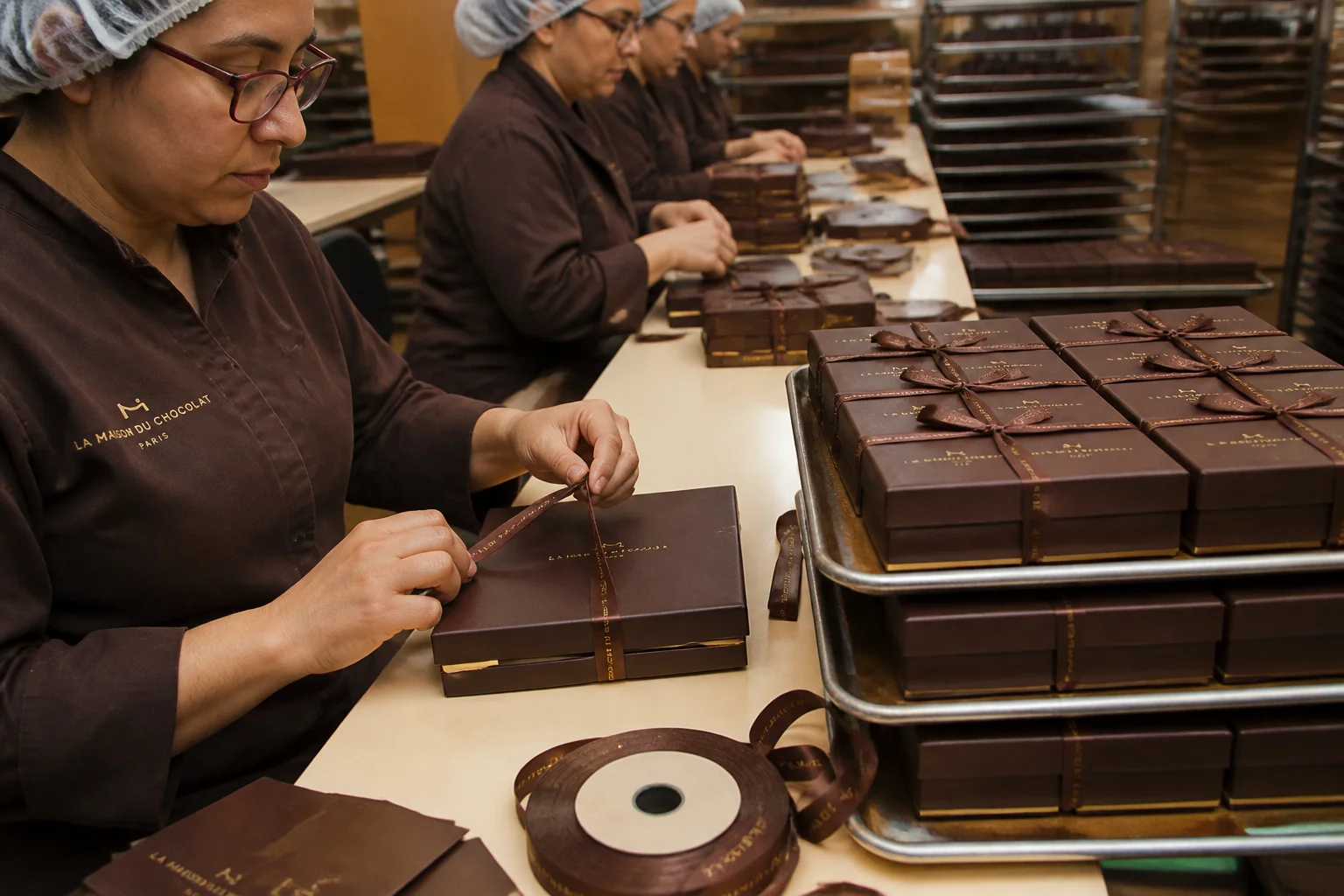
The third fix came from a detail we only discovered by asking. Vandel's packing stations use a wall-mounted dispensing rack, and their previous supplier shipped ribbon on spools with a core too wide for the rack spindle. Their staff had been manually rewinding ribbon onto compatible spools — roughly forty minutes of labor per shift, every shift, across three packing lines.
We changed the spool core diameter to match their equipment and increased the yardage per spool from 100 to 250 yards. Rewinding was eliminated, and spool changeovers dropped by roughly 60%.
A Note on Material Choice
One question Vandel raised early on was whether they should switch from satin to a textured grosgrain for better knot security on their packing line. It is a reasonable question, and the answer turned out to be no — but for reasons worth explaining.
Grosgrain grips better and ties faster, which would have helped their throughput. However, Vandel's boxes are small, and their ribbon width is only 3/8 inch. At that width, grosgrain's ribbed texture becomes visually busy and slightly coarse, which conflicted with the smooth, minimal aesthetic of their matte black box. We produced samples in both materials, sent them physical swatches on actual box mockups, and let their design and operations teams decide together. They chose to stay with satin and instead solved the tying speed issue through the spool change described above.
We mention this because the right answer in B2B sourcing is not always the technically superior material. It is whichever material serves both the operation and the brand. A supplier who pushes one recommendation without testing against your actual product is guessing.
The Numbers After Twelve Months
Vandel's procurement team presented these figures internally at their annual review:
Unit cost: Down 9% versus their previous blended distributor pricing, achieved through direct sourcing rather than any reduction in specification.
Emergency freight: Zero incidents, versus two in the prior year at a combined cost of roughly €11,000.
Peak lead time: Reduced from 5–11 weeks to 10–14 days.
Packing labor: Approximately 120 minutes per day recovered across three lines.
Retail color complaints: Reduced from six in the prior year to zero.
What Made This Work
None of these fixes were technically difficult. What made them possible was a willingness on both sides to look past the purchase order and examine the actual operation. We asked about their packing stations. They shared their forecast data. Neither of those conversations happens in a transactional vendor relationship.
If your team is managing seasonal packaging demand and dealing with unpredictable suppliers, color drift, or manual workarounds on the packing line, those are solvable problems. Send us your specifications and a description of how your line actually runs, and we will come back with a concrete proposal — samples first, promises second.